
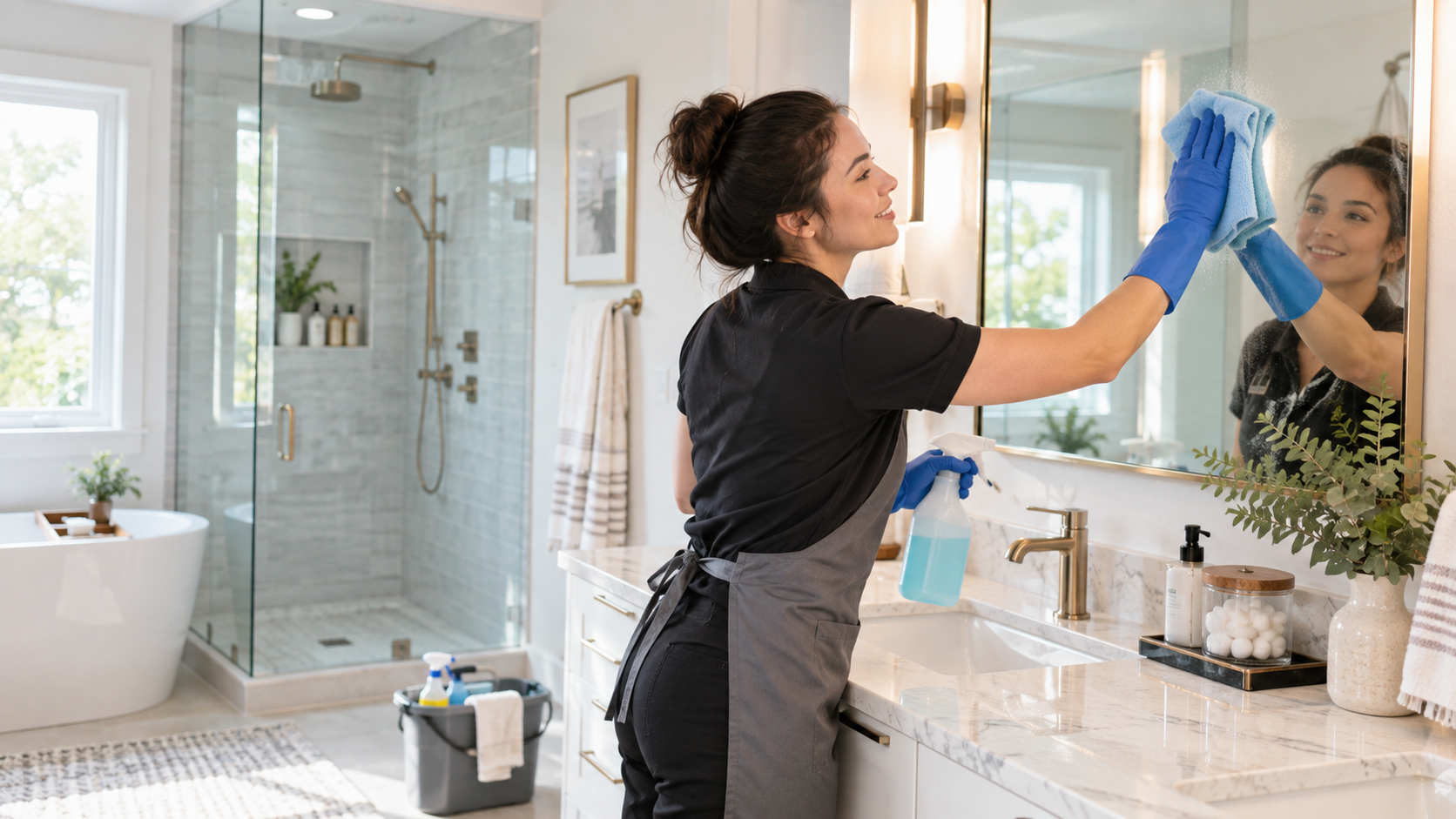
There is clean, and then there is bathroom clean.
You can wipe the sink, swish a brush around the toilet, and call it a day. Then sunlight hits the shower door and suddenly every water spot from the past six months is visible. The grout looks darker than you remember. There is dust on the baseboard behind the toilet. Somehow the faucet already has spots again.
Bathrooms are small rooms, but they are surprisingly demanding. Water, soap, toothpaste, hair, body oils, hard-water minerals, humidity, and everyday dust all end up in the same few square feet.
That is why bathroom cleaning services have become a common add-on to regular house cleaning and, in some cases, a separate service people book on its own.
In 2026, professional cleaning of a bathroom by itself commonly costs around $70 to $170 in the United States. The final price depends on the bathroom size, whether you want standard or deep cleaning, how much buildup is present, and whether the company charges by the room, hour, or complete job.
And no, paying someone to clean a bathroom is not automatically extravagant.
If you have three bathrooms, a glass shower enclosure, textured tile, kids, pets, hard water, and a calendar that already looks ridiculous, spending money to get those hours back can make perfect sense.
How Much Do Bathroom Cleaning Services Cost in 2026?
If you hire a company to clean only one bathroom, current national pricing commonly falls around $70 to $170.
If bathroom cleaning is part of a whole-house visit, the cost is usually rolled into the overall cleaning price instead. Professional standard house cleaning currently averages roughly $118 to $238 per visit, with price increasing as you add bedrooms, bathrooms, square footage, and extra tasks.
Each additional bathroom can add around $10 to $40 to a standard whole-home cleaning quote.
Deep cleaning costs more because the cleaner spends additional time on buildup, edges, fixtures, grout, doors, trim, and areas that are normally skipped during a quick weekly reset.
| Bathroom Cleaning Service | Typical 2026 U.S. Cost | What to Expect |
|---|---|---|
| One bathroom, standard cleaning | About $70-$120 | Routine cleaning of fixtures, toilet, sink, mirror, shower or tub, and floor |
| One bathroom, deeper cleaning | About $100-$170+ | Extra work on buildup, grout, shower doors, edges, and harder-to-reach areas |
| Additional bathroom in a house-cleaning visit | About $10-$40 extra | Added to the full-house cleaning price |
| Professional house cleaning | About $118-$238 per visit | Bathrooms plus bedrooms, kitchen, living areas, and other included rooms |
| Whole-house deep cleaning | About $230-$600 | More detailed cleaning throughout the home |
These are national planning ranges, not fixed prices.
A cleaner in Manhattan, San Francisco, or Seattle may charge considerably more than one in a smaller city. The condition of the room matters too. Cleaning a regularly maintained guest bathroom is not the same job as removing months of soap scum from a heavily used primary bathroom.
What Does Standard Bathroom Cleaning Include?
Every company defines “standard cleaning” a little differently, so read the checklist before booking.
Still, there is a fairly predictable core.
- Cleaning and wiping the sink and vanity
- Cleaning faucets and other fixtures
- Cleaning the toilet bowl, seat, lid, tank exterior, and surrounding area
- Wiping the bathtub or shower surfaces
- Cleaning mirrors
- Wiping accessible countertops and shelves
- Removing visible dust from accessible surfaces
- Emptying bathroom trash
- Vacuuming or sweeping the floor
- Mopping the floor
- Wiping commonly touched areas such as handles and switches when included
That sounds simple until you remember how many surfaces a normal bathroom contains.
Glass, chrome, porcelain, ceramic tile, natural stone, painted walls, laminate, quartz, grout, stainless steel, wood cabinets – sometimes all in one room.
A good cleaner does not treat all of them with the same chemical.
Standard Cleaning vs. Deep Bathroom Cleaning
This is where service descriptions can get fuzzy.
A company may advertise “deep cleaning,” while another company includes many of the same tasks in its regular service. So compare the actual checklist, not just the package name.
| Task | Standard Cleaning | Deep Cleaning |
|---|---|---|
| Sink and faucet | Yes | Yes, with more attention to buildup and edges |
| Toilet | Yes | Yes, including harder-to-reach areas where accessible |
| Mirror | Yes | Yes |
| Tub or shower | Routine surface cleaning | Detailed soap-scum and mineral-buildup removal |
| Shower glass | Basic wipe | More detailed water-spot and soap-scum cleaning |
| Grout | Surface cleaning | More intensive scrubbing where appropriate |
| Baseboards | Sometimes | Commonly included |
| Doors and trim | Spot cleaning | More thorough wiping |
| Cabinet interiors | Usually not | Often an add-on if emptied |
| Heavy mold remediation | No | Usually not part of normal cleaning service |
If your bathroom is cleaned every week, paying for a full deep clean every visit would usually be unnecessary.
If nobody has touched the shower grout since the last season of your favorite show premiered, well, that is a different situation.
Why Bathrooms Take So Much Work
Bathrooms combine water with residue.
Soap mixes with body oils. Minerals remain behind when water evaporates. Hair collects around drains and corners. Moisture makes dust stick to surfaces instead of simply blowing away.
Then you have the toilet, which understandably receives more hygiene attention than the bookshelf in the living room.
Because many bathroom surfaces are shiny, they are also unforgiving. One streak on matte tile can disappear. One streak across a large bathroom mirror looks like someone drew a highway through it.
This is why a small bathroom can sometimes take nearly as much effort as a much larger bedroom.
How Long Does Professional Bathroom Cleaning Take?
A maintained bathroom can often be cleaned fairly quickly. A heavily used bathroom that needs detailed shower, grout, and fixture work can take much longer.
For deep cleaning, around an hour per bathroom is a realistic starting point for many situations, though larger or heavily soiled rooms may take longer. A professional team can move faster because cleaners work in a set order and often divide tasks.
The condition of the shower tends to be the wildcard.
A simple tub with a shower curtain can be quick. A large walk-in shower with floor-to-ceiling glass, niches, textured tile, grout lines, chrome fixtures, and a bench is practically its own cleaning project.
Hard Water Can Turn a Normal Cleaning Into a Project
If your home has hard water, you already know the look.
White haze on shower glass. Chalky buildup around faucets. A crusty ring near the showerhead. Spots that return almost immediately after cleaning.
That residue is largely mineral scale left behind when water dries.
The longer it stays, the harder it may be to remove. This is one reason two bathrooms of exactly the same size can receive very different cleaning quotes.
A cleaner who spends 10 minutes wiping clean shower glass has a very different job from someone spending 45 minutes working on years of mineral deposits.
For delicate materials, though, stronger is not always better.
Natural stone such as marble can be damaged by acidic cleaners commonly used for mineral deposits. A professional cleaner should know what surface they are working on before reaching for a product.
Grout: The Part Everyone Hopes Someone Else Will Do
Grout is porous, recessed, and conveniently located between hundreds of tiles.
Basically, it was designed by someone who did not enjoy cleaning.
Routine mopping can remove surface dirt, but grout lines may gradually darken from residue and moisture. Detailed grout cleaning often requires a brush, the correct cleaning solution, dwell time, and a fair amount of patience.
Do not assume all discoloration can be scrubbed away.
Old grout can be permanently stained. It can also be worn, cracked, or missing in places. Cleaning does not repair damaged grout.
If grout continues looking dark immediately after a thorough cleaning, restoration, recoloring, sealing, or replacement may be the next conversation.
Shower Glass Is Its Own Battle
Few surfaces make a freshly cleaned bathroom look better than clear shower glass.
Few surfaces expose neglect faster either.
Soap residue, hard-water minerals, shampoo, and constant water droplets can create a cloudy film that ordinary glass cleaner barely touches.
Professional bathroom cleaning services may treat shower glass separately during a deep clean because it often needs more time than a mirror.
There is also a point where staining or etching becomes permanent.
If minerals have been sitting on glass for years, they can sometimes damage the surface itself. Cleaning removes deposits. It cannot reverse actual glass damage.
What About Mold Around the Shower?
A few dark spots on shower caulk and a large moisture problem inside a wall are not the same thing.
Light surface growth in ordinary wet bathroom areas may be handled during cleaning, depending on the company. Widespread or recurring mold, however, can point to a leak, failed caulk, poor ventilation, or another moisture source.
The EPA’s current guidance is worth remembering: simply killing mold is not enough. The mold has to be physically removed, and the moisture problem has to be corrected or it can return.
Routine bleach use is not automatically the answer either.
If a cleaning company promises that spraying bleach over a recurring mold problem will permanently solve it, be skeptical.
A bathroom cleaner can clean surfaces. A hidden leak or extensive mold contamination may require a plumber, contractor, or remediation specialist instead.
Cleaning and Disinfecting Are Not the Same Thing
People often use these words as though they mean exactly the same thing.
They do not.
Cleaning physically removes dirt, residue, and many germs with water, detergent, and scrubbing. Disinfecting uses an appropriate chemical product to kill remaining germs on a surface.
Current CDC guidance says that for most normal homes, routine cleaning with soap or detergent is enough for many surfaces. Extra disinfection becomes more relevant when someone is sick or when a person at higher risk is present.
That matters in bathrooms because there is sometimes a temptation to spray hospital-strength disinfectant onto everything every day.
More chemical does not automatically mean more clean.
If disinfecting is needed, the surface should generally be cleaned first and the disinfectant should remain wet for the contact time given on the product label.
Spraying and instantly wiping may not provide the result the label describes.
Please Don’t Mix the Cleaning Chemicals
This sounds basic, yet it is important enough to repeat.
Never mix household bleach with other cleaners or disinfectants unless a product specifically instructs you to do so – and household products generally do not.
Bleach mixed with ammonia or certain acids can release dangerous gases.
Bathrooms are small enclosed rooms too, which makes ventilation especially important while chemical products are being used.
A professional cleaner should follow label instructions rather than creating a homemade chemistry experiment beside your bathtub.
When Is a Bathroom-Only Cleaning Worth It?
You do not always need to hire someone for the entire house.
Bathroom-only service can make sense before guests arrive, after a renovation, when moving into a new property, before listing a house for sale, or when the bathrooms are the one part of housework you absolutely hate.
It can also be practical for older adults, people with limited mobility, or anyone who finds kneeling beside a bathtub or reaching into a shower physically difficult.
Bathrooms contain wet floors, tight spaces, and awkward reaching angles. Sometimes paying someone else is less about luxury and more about not spending Sunday afternoon crawling around a toilet with a toothbrush.
Is Recurring Cleaning Cheaper?
Often, yes.
Many cleaning companies charge less per visit when they come weekly or every two weeks because the home never gets as dirty as it would between occasional appointments.
A bathroom maintained every two weeks may need routine wiping, scrubbing, and mopping.
The same bathroom cleaned twice a year may require much more work on soap scum, grout, baseboards, mineral scale, and corners.
Recurring cleaning also makes pricing more predictable. Once the first visit establishes the condition of the home, later appointments often follow the same routine.
What About Move-In and Move-Out Bathroom Cleaning?
Move-out cleaning is usually more detailed than a standard maintenance visit.
The room is empty, so cleaners can reach areas that are normally blocked by baskets, organizers, bath mats, toiletries, and personal items.
Cabinet interiors may be cleaned. Drawers may be wiped. Baseboards and doors get more attention.
For move-in cleaning, many people also want the bathroom cleaned before toiletries and towels are unpacked.
It is much easier to clean an empty vanity than one containing 46 bottles that you apparently needed to move from your last house.
What Makes the Price Go Up?
Bathroom cleaning quotes are mostly about time.
The longer the room will take, the more the service tends to cost.
- Large primary bathrooms with separate tubs and showers
- Multiple toilets or double vanities
- Heavy soap scum or hard-water buildup
- Large glass shower enclosures
- Extensive grout
- Textured or difficult-to-clean tile
- Long periods between cleanings
- Pet hair or heavy dust
- Extra services such as cabinet interiors or organizing
- Specialty surfaces requiring specific products
- Difficult access or heavy clutter
- High local labor costs
The phrase “one bathroom” does not tell a cleaner very much.
A tiny powder room with a toilet and sink can be done quickly. A 200-square-foot primary suite with a soaking tub and giant tiled shower is practically a spa.
Do Cleaners Bring Their Own Supplies?
Many professional services bring cleaners, microfiber cloths, brushes, mops, and vacuum equipment.
Others expect the homeowner to supply certain products. Independent cleaners may be more flexible about using whatever you already have at home.
If you have marble, natural stone, specialty finishes, or a strong preference for fragrance-free products, mention that before the appointment.
Do not wait until the cleaner has already sprayed the stone vanity to announce that the manufacturer requires a pH-neutral product.
What About “Green” Bathroom Cleaning?
Many companies now offer lower-fragrance, plant-based, or environmentally oriented product options.
That can be useful for households that dislike strong scents or prefer certain ingredients.
But “green” is a broad marketing term, not one universal cleaning standard.
Ask what products will actually be used if this matters to you.
And remember that product choice still has to match the surface. A gentle cleaner can work beautifully for routine maintenance but may not remove severe mineral scale in one pass.
How Often Should a Bathroom Be Professionally Cleaned?
There is no official schedule every household needs to follow.
A busy family bathroom may need cleaning several times a week, although that does not mean you need a professional there every Tuesday and Friday.
Many households combine light DIY maintenance with a professional visit every one or two weeks.
Others book a monthly clean or occasional deep cleaning.
A rarely used guest bathroom obviously needs less work than the bathroom used every morning by two adults, three kids, and a teenager who somehow owns nine different hair products.
The right schedule is the one that keeps buildup manageable.
How to Prepare Before the Cleaner Arrives
A little preparation can mean more of your paid cleaning time goes toward actual cleaning rather than moving shampoo bottles around.
- Remove clothing, towels, and bath mats from the floor
- Clear toiletries from crowded counters when possible
- Empty the shower of products if you want all surfaces thoroughly cleaned
- Put away medications, jewelry, cash, and personal documents
- Tell the cleaner about delicate stone or specialty surfaces
- Mention known leaks, loose fixtures, cracked tile, or damaged grout
- Make sure water and electricity are available
- Keep pets away from the work area if needed
- Discuss any areas you do not want cleaned
- Confirm requested add-ons before the appointment begins
You do not need to clean before the cleaner arrives.
That would rather defeat the point.
Just make the surfaces accessible.
Should You Tip a Bathroom Cleaner?
Tipping is appreciated but not always required.
If an independent cleaner sets their own rate, some clients do not tip routinely. Employees of larger cleaning companies are more likely to receive tips from satisfied customers.
For one-time or difficult jobs, 10% to 20% is a common range when you want to leave a tip, but there is no universal U.S. rule.
You can also tip a flat amount.
For recurring cleaners, some households skip tipping each visit and give a larger holiday bonus instead.
How to Compare Bathroom Cleaning Services
Price matters, but a $20 difference becomes less important if one company includes shower glass, grout, and baseboards while another charges separately for all three.
Ask for the checklist.
Find out whether the service has a minimum booking price. A company may technically charge $70 for a bathroom but require a $120 minimum appointment.
Ask whether cleaning supplies are included and whether extra time is billed automatically if the room takes longer than expected.
Insurance matters too.
If someone accidentally damages an expensive stone counter or breaks a glass shower door, you want to know how the company handles claims.
Red Flags Worth Paying Attention To
A cleaning company does not need a fancy website or matching uniforms to be good.
But basic communication should be clear.
Be cautious if nobody can explain what the quoted price includes, if the company refuses to discuss damaged-item policies, or if an unusually cheap advertised price suddenly turns into a list of required add-ons once the cleaner arrives.
Also be realistic about impossible promises.
Cleaning can remove dirt and buildup. It cannot restore cracked grout, replace failed caulk, repair etched glass, fix rusty fixtures, or solve moisture behind a wall.
A professional should tell you when something needs repair rather than more scrubbing.
Can You Just Clean the Bathroom Yourself?
Of course.
Bathroom cleaning services are convenience services, not a requirement for owning a home.
If you have the time and do not mind the work, most routine cleaning is completely manageable without a professional.
The argument for hiring someone is mostly time, effort, consistency, and occasionally equipment or experience with stubborn buildup.
Do the math based on your life rather than someone else’s.
If cleaning two bathrooms takes you three hours and ruins your Saturday mood, paying $120 may feel like an excellent deal.
If you genuinely enjoy cleaning, put on music and keep the money.
FAQ
How much do bathroom cleaning services cost in 2026?
Cleaning one bathroom by itself commonly costs about $70 to $170 in the U.S. Standard maintenance tends to sit toward the lower end, while larger bathrooms, deep cleaning, heavy buildup, and specialty surfaces can push the price higher.
What is included in professional bathroom cleaning?
A typical service includes the toilet, sink, vanity, faucet, mirror, shower or bathtub, accessible surfaces, trash, and floor. Deep cleaning may add more detailed work on grout, shower glass, baseboards, doors, corners, and mineral buildup.
How long does it take to professionally clean a bathroom?
A maintained bathroom may take less than an hour, while detailed deep cleaning can take an hour or longer. Large walk-in showers, hard-water scale, extensive grout, and heavy buildup add time.
Do bathroom cleaners disinfect everything?
Not necessarily. Cleaning and disinfecting are different tasks. Routine household cleaning is enough for many surfaces, while disinfection may be appropriate when someone is sick or when specifically requested. Check the company’s service description.
Can professional cleaners remove bathroom mold?
Small amounts of surface mold or mildew may be cleaned as part of some services. Recurring, widespread, or hidden mold needs the moisture source investigated and may require professional remediation rather than ordinary bathroom cleaning.
Do cleaners bring their own bathroom cleaning products?
Many companies bring their own products and equipment, but policies vary. Tell the service in advance if you have natural stone, specialty finishes, allergies, pets, or preferences for fragrance-free or specific cleaning products.
Is deep bathroom cleaning worth the extra cost?
It can be when soap scum, mineral deposits, grout discoloration, dust, and neglected edges have built up over time. If the bathroom is already cleaned regularly, a standard maintenance service may be enough.
Conclusion
Bathroom cleaning services are one of those household expenses that can sound unnecessary until you calculate how much time you spend scrubbing bathrooms every month.
In 2026, hiring someone to clean a single bathroom commonly costs around $70 to $170 in the United States. If the bathroom is part of a regular whole-house service, the cost is normally bundled into the overall visit, which often falls around $118 to $238 for standard cleaning.
But the useful number is not really the national average.
It is the price for your bathroom.
A small powder room with a sink and toilet may be quick. A primary bathroom with natural stone, double sinks, a soaking tub, a large glass shower, and miles of grout is a different job.
Before booking, ask exactly what the service includes.
Does the cleaner scrub grout? Are shower doors included? What about baseboards? Will mineral scale be treated? Do they clean behind the toilet? Are cabinet interiors extra?
Those details make comparing prices much easier.
Also keep expectations realistic. A good cleaner can make a neglected bathroom look dramatically better. They cannot repair cracked tile, replace old caulk, reverse permanently etched glass, or solve a hidden leak.
And when mold keeps returning, the answer is usually not simply stronger cleaner. Moisture has to be controlled too.
For routine household hygiene, you also do not need to disinfect every square inch every day. Regular cleaning removes dirt and many germs, while targeted disinfection is more useful when illness or another specific reason makes it necessary.
The best schedule depends on how your household lives.
Maybe that means a cleaner every week. Maybe every two weeks. Maybe you clean normally yourself and book a serious deep cleaning four times a year.
There is no prize for doing it the hardest possible way.
If professional bathroom cleaning gives you a spotless shower, clear glass, clean grout, and two hours of your weekend back, the calculation may be pretty easy.
You close the bathroom door.
Someone else deals with the grout.
Not a bad arrangement.
Leave a Reply