
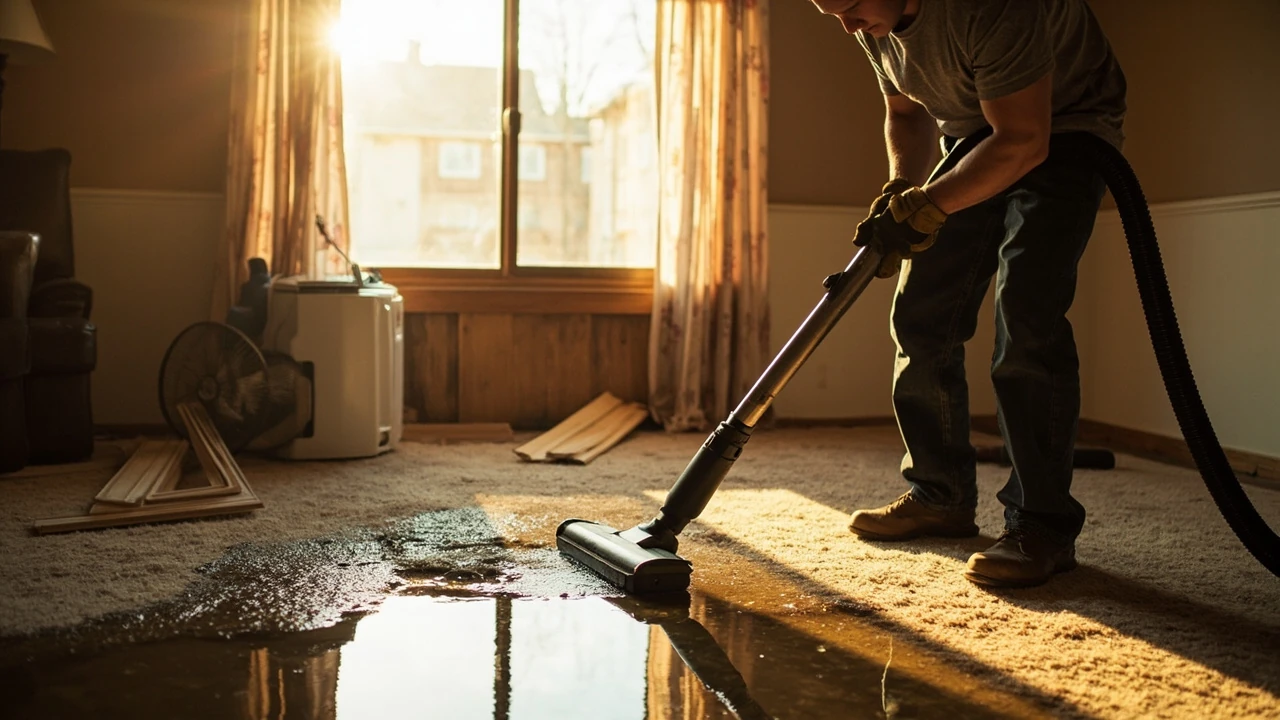
Water damage cleanup
A supply line under the kitchen sink splits at 2 a.m. By the time you find it, several gallons of water have soaked the cabinet base, the vinyl floor, and the corner of the adjoining dining room. The carpet is spongy, the drywall is darkening at the bottom, and a small musty smell is already starting. What you do in the next 24 hours decides whether you end up with a drying bill or a demolition bill.
Water damage cleanup is the structured process of removing standing water, drying out the structure, sanitizing affected materials, and preventing secondary damage like mold growth. Done well, it limits cost, protects indoor air quality, and gets the home back to a normal living condition quickly. Done poorly, it sets the stage for hidden mold, ruined subfloors, and insurance disputes that drag on for months.
This guide walks through how water damage cleanup actually works in a home, from the first safe step through the final rebuild. It is written for homeowners who want to understand the process, not for restoration contractors, and it is built around practical decisions: what you can safely do yourself, what you should leave to a certified crew, and how to think about cost, timing, and insurance.
How water damage is classified
Restoration professionals do not treat every water loss the same way. Before any drying equipment is placed, the loss is sorted into a category and a class. These two classifications drive the equipment list, the safety gear, the disposal rules, and the price.
Category: where the water came from
The category describes how contaminated the water is and how much risk it poses to health. The IICRC S500 standard, which most U.S. restoration firms follow, defines three categories:
- Category 1 (clean water): Water from a sanitary source such as a broken supply line, a faucet overflow, or a melting ice dam. It poses little health risk at the moment of release, but it can degrade into a worse category if it sits in the structure long enough.
- Category 2 (gray water): Water that contains significant contamination. Examples include discharge from a washing machine or dishwasher, sump pump failure, or toilet overflow that contains urine but no feces. Contact requires protective equipment and more aggressive cleaning.
- Category 3 (black water): Grossly unsanitary water from sewage backups, river or stream flooding, storm surge, or standing water that has been present long enough to support bacterial growth. Porous materials contacted by Category 3 water are usually removed and discarded rather than cleaned.
Class: how much surface is wet and how deeply
The class describes the volume of water absorbed and the evaporation challenge it creates. It decides how many air movers and dehumidifiers the job needs.
- Class 1: Less than about 5 percent of the combined floor, wall, and ceiling area is wet. A small dishwasher leak that is caught quickly often falls here.
- Class 2: Roughly 5 to 40 percent of the combined area is wet, with moisture in carpet pad, gypsum board, and similar porous materials. A burst pipe in a second-floor bathroom is a typical example.
- Class 3: More than 40 percent of the combined area is wet, often with saturation of ceilings, walls, insulation, and subfloor. A washing machine hose that runs for hours can push a room into Class 3.
- Class 4: Deeply bound water in low-evaporation materials like hardwood, plaster, concrete, or built-up assemblies. Drying requires specialty equipment and longer run times.
You do not need to memorize the thresholds, but it helps to know what a restoration estimator is looking at when they walk through the room.
The first 24 hours: what to do before the pros arrive
If you call a restoration company, response time usually falls in the 1 to 4 hour window for emergencies, especially after hours. What you do in the gap matters.
Step 1: protect people first
Do not enter a flooded room if the water has reached electrical outlets, the service panel, or any plugged-in appliance. Turn off the breaker for the affected area from a dry location if you can do so safely. Keep children, pets, and anyone with a weakened immune system out of the space.
If the water is from a clean source, is shallow (under an inch), and you have rubber boots and gloves, you can usually enter to grab valuables and start removing water with a wet-dry vac. If the water is from a sewer backup or outside floodwater, do not enter without proper PPE, and consider it Category 3 by default.
Step 2: stop the source if you can
For a supply line leak, the main shutoff is usually near the water meter or where the main enters the house. Fixture shutoffs are under toilets and behind sinks. A single failed supply line can release 250 gallons in a day from a 1/8-inch crack, so closing the valve is more useful than mopping.
For a roof leak during a storm, a tarp placed from the eaves upward over the ridge is a reasonable temporary fix if it is safe to climb. For a sump pump failure, a backup pump or a generator on the existing pump can keep water from re-accumulating while you wait.
Step 3: document everything for insurance
Before you move anything, take wide shots of each affected room, close-ups of the source, and video that pans slowly across water lines on walls and baseboards. Save receipts for any emergency supplies, plumber visits, or hotel stays if the home is uninhabitable. This is the evidence that turns a phone call into a paid claim.
Step 4: start removing water you can see
A household wet-dry vac can pull up to 10 or 15 gallons before the bucket needs to be emptied, which is helpful for small Category 1 jobs. For larger losses, a restoration company will bring a truck-mounted extractor. The goal in the first 24 hours is to get standing water off the floor and out of the carpet pad, because every hour water sits on a porous material, the drying job gets harder.
| Time since water event | What is happening in the structure | What a homeowner can still do |
|---|---|---|
| 0 to 2 hours | Water wicks into drywall, carpet pad, and wood. Swelling starts at seams. | Stop the source, shut off power to wet zones, document, begin extraction. |
| 2 to 24 hours | Drywall softens, wood begins to cup, furniture wicks moisture into legs and joints. | Move dry items to a safe space, lift carpet off pad, set up fans, call a pro. |
| 24 to 48 hours | Mold spores can colonize on wet paper-faced drywall, paper-backed insulation, and natural fiber carpet. | Begin aggressive drying, remove unsalvageable porous materials, run a dehumidifier. |
| 48 hours to 1 week | Mold growth visible on surfaces, musty odor, subfloor swelling, metal fasteners staining. | Limited DIY options. Professional containment, HEPA air scrubbing, and controlled demolition are usually required. |
What professional water damage cleanup actually involves
A good restoration company follows a predictable sequence. Knowing the steps helps you evaluate whether the crew is doing the work or just running fans.
Inspection and moisture mapping
The lead technician will use a thermal imaging camera to find cold, wet areas behind walls and under cabinets, then confirm with a pin or pinless moisture meter. They should document wet zones on a sketch or in a drying plan. The drying plan is what insurance adjusters usually ask for, and it is the basis for the equipment list.
Water extraction
Extraction is the single most cost-effective step in the whole job. Removing a pound of water with a truck-mounted extractor costs a fraction of what it costs to pull that same pound out of the air with a dehumidifier. On carpet, weighted extraction can pull 80 to 90 percent of the water out of the pad without lifting it, which dramatically shortens the dry-out.
Demolition of unsalvageable materials
Wet drywall is usually cut out 12 to 24 inches above the visible water line, because wicking continues after the visible edge. Wet insulation behind that drywall comes out with it. Carpet pad is almost always replaced; carpet itself is sometimes cleaned and re-installed if it dried quickly and the water was Category 1. Cabinet kick plates and toe kicks are often removed to dry the underside. For additional context, Anything porous that contacted Category 3 water is removed and discarded, not cleaned.
Setting up the drying system
Once the structure is open, the crew will place air movers to push evaporated moisture off wet surfaces and one or more refrigerant or desiccant dehumidifiers to pull that moisture out of the air. A typical Class 2 room might need 4 to 6 air movers and 1 to 2 dehumidifiers for 3 to 5 days. The equipment runs 24 hours a day and is monitored daily.
Cleaning and sanitizing
Surfaces that stayed in place are wiped down, and an EPA-registered antimicrobial is applied where appropriate. This is not the same as fogging, and it is not a substitute for removing wet porous material. For Category 2 and 3 losses, the cleaning step matters more, and a HEPA-filtered air scrubber is often left running alongside the drying equipment.
Verification and rebuild
Before the equipment is pulled, the technician returns with a moisture meter and confirms that affected materials are back to the dry standard for that material type in that climate. Only then should rebuild begin: new insulation, new drywall, paint, flooring, and trim. Rushing the rebuild before the structure is truly dry is one of the most common and expensive mistakes in residential restoration.
Safety issues that change the rules
Some water damage situations are not just an inconvenience. They are a hazard that needs a different response.
Electrical risk
Water and energized wiring are a lethal combination. If water has reached outlets at or above floor level, the breaker for that area needs to stay off until the structure is dry and an electrician has confirmed the circuits. Subpanels in basements, garages, and closets are particularly vulnerable. A standing-water level above any energized device is a job for the utility, not a homeowner with a mop.
Sewage and outdoor floodwater
Water from a backed-up sewer, a river that has crested, or storm surge that has entered the home is treated as Category 3. Beyond the immediate contamination, floodwater can carry oils, fuels, and chemicals from yards, roads, and basements. Children, pregnant people, and anyone with a respiratory condition should not be in the space until it has been cleaned and the air quality verified.
Structural risk
A saturated ceiling can hold enormous weight and may sag or fail without warning. Standing water in a crawl space can float a furnace or a water heater and damage gas lines. If you see bulging ceilings, hear creaking, or smell gas, leave the building.
Mold and indoor air quality
Mold colonies can become established within 24 to 48 hours on paper-faced drywall, paper-backed insulation, and natural-fiber carpet. Once established, they release spores and microbial fragments that aggravate asthma and other respiratory conditions. A persistent musty odor after a water event is a signal that moisture is still present somewhere, even if the surfaces look dry.
Drying the home without a restoration company
For small Category 1 losses that are caught early, a homeowner can sometimes handle the dry-out without a professional crew. The conditions for a realistic DIY job are narrow.
When DIY is reasonable
- The loss is small, well under 50 square feet, and confined to a hard-surface floor with no water migration into walls.
- The water is from a clean source and was mopped or extracted within a few hours.
- There is no wet padding, no wet drywall, and no visible moisture in the subfloor.
- You have a wet-dry vac, at least one oscillating fan, and a refrigerant dehumidifier.
When to call a pro instead
- The wet area is larger than a single room, or water has migrated to adjacent rooms through a hallway.
- Water has wicked up drywall more than a few inches or is visible behind baseboards.
- Carpet or pad is wet, hardwood floors are cupping, or the ceiling is stained or sagging.
- The source is a sewer, a sump pump, or outside floodwater, or the water has been standing for more than 24 hours.
- You smell a persistent musty odor, or anyone in the home has asthma or a respiratory condition that is flaring.
| DIY scenario | Likely effective? | Main reason |
|---|---|---|
| Bathroom sink overflow caught in 10 minutes, hard floor only | Yes | Small volume, clean source, no porous materials affected. |
| Refrigerator supply line leak, kitchen vinyl floor, caught within an hour | Often | Clean water, small area, but check under the fridge and behind the baseboard for migration. |
| Washing machine hose burst, water on carpet and pad for several hours | Rarely | Pad is almost certainly saturated, water has wicked into baseboards, and the drying job is much larger than it looks. |
| Toilet backup with solid waste, any standing water | No | Category 3 contamination. Porous material removal and professional sanitizing are required. |
| Roof leak during a long storm, ceiling sagging, insulation wet above | No | Hidden moisture, structural risk, and likely electrical involvement. Needs a contractor. |
Cost, insurance, and what is usually covered
Water damage cleanup costs are driven by the class and category of the loss, the size of the affected area, and how long the water was present. Industry surveys put the national average for professional water damage cleanup somewhere in the $1,500 to $5,000 range for a typical single-room, mid-grade loss, with larger or more contaminated jobs scaling up from there. Pricing varies widely by region and by the scope of demolition, so any specific number is a rough reference rather than a quote.
What standard homeowners insurance usually covers
Most policies cover sudden and accidental water damage from inside the home, such as a burst pipe, a failed water heater, or a washing machine hose that ruptures. They also typically cover the cost of mitigation, which is the work done to prevent further damage, including extraction, drying, and demolition of wet materials that cannot be saved.
What standard homeowners insurance usually does not cover
- Flood damage from outside the home, including rising water, storm surge, and groundwater seepage. That requires a separate flood policy, usually through the National Flood Insurance Program.
- Damage from a slow leak that has been ongoing for a long time, because it is considered a maintenance issue rather than a sudden event.
- Sewer and drain backups unless a specific endorsement or rider has been added. This add-on is often called sewer and drain coverage and is usually inexpensive.
- Water damage caused by neglect. If a homeowner knew about a leaking pipe and did nothing, the claim can be reduced or denied.
How to work a claim without losing money
- Report the loss as soon as it is safe to do so. Most carriers have a 24/7 claims line.
- Keep a dedicated folder, physical or digital, for receipts, photos, the drying plan, and every email with the adjuster.
- Ask the restoration company to bill the insurer directly whenever possible. This is standard practice and protects you from large out-of-pocket deposits.
- Save damaged materials for the adjuster to see, or take clear photos before removal. Insurers can question disposal that happens before the adjuster’s visit.
- Keep a written log of any temporary housing costs, since loss-of-use coverage is a separate part of the policy.
Preventing the next loss
Most water damage in U.S. homes comes from a small set of predictable causes. A short, seasonal maintenance routine catches most of them before they become a claim.
Plumbing and appliances
Inspect supply lines to the washing machine, dishwasher, refrigerator, and toilets once a year. Braided steel lines last longer than rubber, but even braided lines should be replaced every 5 to 7 years. Replace angle stops under sinks when you replace faucets. If a home is going to be unoccupied for more than a couple of weeks in winter, consider shutting off the main and draining the lines.
Roof, gutters, and envelope
Clean gutters in spring and fall. After major wind events, walk the perimeter and look for lifted shingles, missing flashing, and sealant that has pulled away from vents and chimneys. Check the grade around the foundation so soil slopes away from the house at least 6 inches over the first 10 feet.
Sump and sewer
If the home has a sump pump, test it by pouring a bucket of water into the sump once or twice a year. A battery backup or a water-powered backup pump is worth considering in areas with frequent power outages or high water tables. Avoid flushing wipes, even those labeled flushable, and avoid pouring grease down the drain.
Leak detection
Point-of-use leak detectors under sinks, behind toilets, and near the water heater cost little and send an alert to a phone when they get wet. Whole-house flow-based systems shut the water off automatically when they see an unusual flow pattern, and some insurance carriers offer a small premium discount for installing one.
| Common cause | Typical warning sign | Realistic prevention |
|---|---|---|
| Washing machine hose burst | Bulge or cracking on the hose, slow drip when not in use | Replace rubber hoses with braided steel; shut valves when away for more than a day. |
| Water heater failure | Rust at the base, water on the floor near the tank | Flush the tank yearly; replace at 10 to 12 years; install a pan with a drain. |
| Refrigerator supply line | Slow drip behind the fridge, water on the floor after the filter change | Replace the plastic line with braided steel; check the connection each time you change the filter. |
| Roof leak | Stains on ceiling after wind-driven rain, granules in the gutter | Annual roof inspection, clean gutters, replace flashing around chimneys and vents. |
| Sewer backup | Multiple fixtures drain slowly during heavy rain, gurgling in a basement floor drain | Install a backwater valve, consider a sewer and drain endorsement, and avoid planting trees near the line. |
When the damage has been going on for a while
Not every water damage cleanup starts with a dramatic burst pipe. A slow leak under a sink, a cracked washing machine pan, or a roof stain that has been quietly spreading for months can produce the same indoor air quality and structural problems as a single-event flood, just on a slower timeline.
In these cases, the cleanup plan often looks more like a remodel. The remediation crew removes the damaged material, treats or removes affected framing, and addresses the source. A contractor then rebuilds the affected area. The good news is that the discovery usually points to one fixable cause. The bad news is that insurance coverage for a long-running leak is harder to secure, because carriers will look for evidence that the homeowner knew or should have known about the problem.
If you find yourself in this situation, a moisture meter reading at the affected area, a plumber’s report, and dated photos of any visible staining are the strongest evidence that the loss is recent and covered.
Putting the pieces together
Effective water damage cleanup is not a single action, it is a sequence. Stop the source, protect the people, document the loss, extract what you can, open up what is wet, dry the structure with the right equipment, clean and sanitize, and only then rebuild. Skipping a step, or doing them out of order, is what turns a $2,000 drying job into a $20,000 rebuild.
For a small, clean, well-contained leak, the homeowner can do most of the work with a wet-dry vac, a fan, a dehumidifier, and patience. For anything larger, anything involving carpet pad, drywall, sewage, or outdoor floodwater, the right move is to call a certified restoration firm and let the drying plan do the talking. Either way, the clock starts when the water hits the floor, and the first 24 hours matter more than the next two weeks.
Frequently asked questions
How long does water damage cleanup usually take?
For a single-room, clean-water loss that is caught quickly, active drying runs 3 to 5 days, with full repair and rebuild often completed within 2 to 4 weeks. Larger losses, contaminated water, or deeply wet materials can push the dry-out to 1 to 2 weeks and the rebuild to 6 to 8 weeks or more.
Can I just open windows and let the house air out?
Air movement helps, but on its own it is not enough in most U.S. climates. Outdoor air often holds more moisture than the wet indoor air, especially in summer. A balanced system of air movers and a refrigerant dehumidifier is faster, more predictable, and less likely to push mold growth into other parts of the home.
Do I need to throw out wet carpet and pad?
The pad almost always needs to be replaced. The carpet itself can sometimes be cleaned and reinstalled if the water was Category 1, the carpet dried within 24 to 48 hours, and there is no visible staining or odor. If the water was Category 2 or 3, both pad and carpet are usually discarded.
Is water damage cleanup covered by homeowners insurance?
Sudden and accidental water damage from inside the home is typically covered. Damage from outside flooding, slow leaks, and sewer backups usually requires a separate policy or endorsement. Coverage is determined by the specific policy and the circumstances, so it is worth reading the declarations page and calling the carrier before any demolition happens.
How do I know if there is mold after water damage?
A musty odor that lingers after drying, visible spots on drywall or trim, and respiratory irritation in people who were fine before the event are all warning signs. A restoration company can confirm with a moisture meter and, if needed, air or surface sampling performed by an industrial hygienist.
Can I stay in the home during water damage cleanup?
For small, clean-water losses confined to a single room, staying in the home is usually fine as long as the affected area is closed off and equipment noise is tolerable. For larger losses, contaminated water, or anyone with respiratory issues, it is safer to arrange temporary housing until drying is complete and air quality is verified.
What is the difference between mitigation and restoration?
Mitigation is the work that prevents further damage: extraction, demolition of unsalvageable materials, drying, and cleaning. Restoration is the work that puts the home back to its pre-loss condition: new drywall, paint, flooring, and trim. Insurance policies usually cover mitigation, and they cover restoration when the underlying cause is a covered loss.
Should I hire a restoration company or do it myself?
Use a restoration company for any loss that involves contaminated water, more than about 50 square feet, wet drywall, wet carpet pad, or any moisture that has been present for more than 24 hours. DIY is reasonable for small, clean, well-contained spills on hard surfaces, caught within the first few hours.
How do I pick a good water damage cleanup company?
Look for IICRC certification, a written drying plan, and billing that goes through insurance when there is a claim. Avoid anyone who shows up uninvited, pressures you to sign immediately, or quotes a price before walking the loss with a moisture meter. Local references and a physical address are a good sign.
What can I do right now to lower the risk of water damage?
Replace washing machine hoses with braided steel, know where the main water shutoff is and that it actually works, install a leak detector under each sink and behind the water heater, and clean the gutters before the next heavy rain. Those four steps prevent a large share of the most common residential water losses.
Leave a Reply