Furnace repair thornton: how to choose and what to expect
A Colorado front-range winter does not negotiate. A furnace that hesitates at 5 a.m. in Thornton can leave a family with shivering kids, frozen pipes, and a service queue three days long. When the system finally gives up, the first instinct is to call whoever answers the phone. The second instinct, the one that actually saves money, is to slow down for ten minutes and figure out what kind of furnace repair thornton visit you actually need.
This guide is written for homeowners in Thornton and the surrounding north-metro area who want a working heater tonight, a fair bill, and a furnace that lasts the rest of the season. It walks through how local heating systems typically fail, what a credible repair visit looks like, when repair stops making sense, and how to tell a real HVAC company from a call center with a Google budget. It is not a substitute for a licensed technician in your home, but it should make that visit cheaper, faster, and more useful.
How Thornton homes are usually heated
Most single-family homes in Thornton were built between the 1980s and the 2010s, with two-story and ranch layouts and basements that often house the mechanical room. The dominant fuel is natural gas supplied by Xcel Energy, and the dominant appliance is a forced-air gas furnace feeding a network of supply and return ducts. Higher-end homes sometimes pair the furnace with a whole-house humidifier or an electronic air cleaner, and newer subdivisions increasingly include heat pumps or dual-fuel systems that switch between gas and electric heat based on outdoor temperature.
That mix matters for repairs because the failure modes differ by equipment:
- Older natural draft furnaces, common in 1980s and early 1990s homes, use a pilot light and a draft hood. They are simple, but they lose efficiency and their heat exchangers crack with age.
- Mid-efficiency condensing furnaces, common from the mid-1990s through the 2010s, use an inducer motor, electronic ignition, and a PVC vent pipe. They are reliable but have more parts that can fail.
- High-efficiency modulating furnaces, increasingly common in newer builds, use a variable-speed blower and a communicating control board. They are efficient but expensive to repair because parts are pricier and diagnostics are more involved.
- Heat pumps and dual-fuel systems are now appearing in newer subdivisions, and they add another layer of controls and refrigerant components on top of the gas furnace.
Knowing which family your equipment falls into tells a technician which parts to bring on the truck and roughly how long a typical service call should take. It also helps you interpret the estimate. A blower motor replacement on a 1998 mid-efficiency furnace is a different job than a control board swap on a 2022 modulating model, and the bills should not look alike.
The most common furnace problems in this climate
Thornton sits in a semi-arid climate with cold, dry winters and large day-to-night temperature swings. Those conditions stress heating equipment in a few predictable ways. The list below covers the issues a local HVAC company is most likely to see in any given week between November and March.
| Symptom you notice | Likely cause | Typical urgency |
|---|---|---|
| No heat at all, thermostat lit, no ignition | Flame sensor covered in carbon, dirty burners, bad igniter, or failed inducer pressure switch | Same day, especially with young children or elderly residents |
| Furnace runs but air feels lukewarm | Dirty evaporator coil, weak blower motor, or restricted return air from a clogged filter | Within 24 to 48 hours |
| Furnace short-cycles, turning on and off every minute or two | Overheating from restricted airflow, cracked heat exchanger, or failing limit switch | Same day; continued use can damage the heat exchanger |
| Burning smell on first cold start | Dust burning off the heat exchanger, usually harmless | Not urgent on its own, but watch for smoke or persistent odor |
| Yellow or flickering flame instead of steady blue | Combustion issue, dirty burner, or possible heat exchanger problem | Same day; shut the furnace off until inspected |
| Water around the base of the furnace | Condensate drain clog, secondary heat exchanger leak, or humidifier leak | Within 24 hours to prevent floor damage |
| Carbon monoxide alarm sounds | Cracked heat exchanger or blocked flue | Immediate; evacuate, ventilate, call a pro, do not run the furnace |
Two of those rows deserve a closer look because they show up in nearly every Thornton winter and they are easy to misjudge from the living room.
Short-cycling and the heat exchanger question
Short-cycling is the symptom that worries technicians most because it can point to a cracked heat exchanger. A heat exchanger is the metal chamber inside the furnace that separates the hot combustion gases from the air you breathe. When it cracks, carbon monoxide can mix with the supply air. The furnace will sometimes still heat the house, which makes the problem easy to ignore. The right move is to stop using the furnace and have a tech measure the temperature rise across the heat exchanger, inspect it with a mirror or camera, and check for CO at the supply registers. If a crack is confirmed, the conversation shifts from repair to replacement, because no credible HVAC company will patch a heat exchanger for safety reasons.
Yellow flame, soot, and combustion air
A healthy gas burner burns with a steady blue flame. Yellow tips, lazy flames, or visible soot at the burner door mean the gas is not burning cleanly. Causes range from dust on the burners to a blocked flue to a cracked heat exchanger. A combustion analysis with a calibrated meter is the standard way to confirm the cause. If you see yellow flames, do not run the furnace longer than necessary, and schedule a service visit before the next cold snap rather than after it.
What a good furnace repair visit actually looks like
Anyone can sell a service call. The difference between a fair furnace repair thornton visit and a frustrating one is the structure of the visit itself. A competent local company will usually run through a sequence that looks roughly like the one below.
- Interview before tools. The tech asks when the problem started, what changed, and what the thermostat is doing. That conversation often points to the failure before the panel comes off.
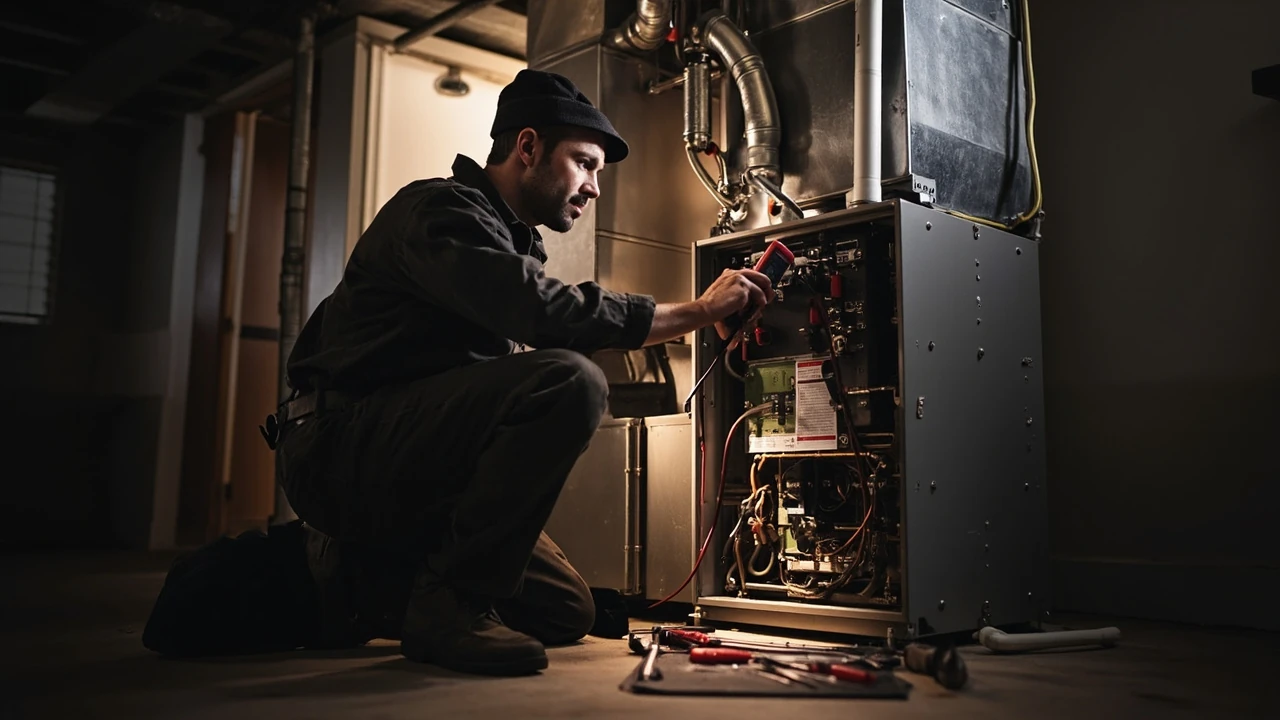
- Visual inspection. The furnace cabinet, venting, condensate lines, filter, and surrounding area are checked. Burners and the heat exchanger are looked at directly.
- Basic measurements. Return air temperature, supply air temperature, temperature rise, static pressure across the blower, and, when warranted, a combustion analysis are taken with a calibrated instrument.
- Diagnosis in plain English. The tech explains what failed, what could have caused it, and what the options are, including the option to leave the furnace as-is for a short time if safety allows.
- Written estimate before work. Labor, parts, and any code-required add-ons are listed. A good company will not start a paid repair without approval.
- Repair, retest, clean up. The fix is performed, the system is run through a full heat cycle, and the work area is left as it was found.
- Paperwork and follow-up. The invoice lists the diagnosis, the work performed, the parts installed with part numbers, and any recommendations for follow-up, such as a humidifier pad change or a duct sealing estimate.
If a visit skips the interview, skips measurements, or hands you a quote before the panel comes off, that is a signal to slow down and ask more questions.
Repair versus replacement: a realistic decision
There is no fixed rule for when to stop repairing a furnace, but a few benchmarks help. The table below summarizes the most common decision points a Thornton homeowner will face, with the reasoning behind each.
| Situation | Repair usually makes sense | Replacement usually makes sense |
|---|---|---|
| Age of furnace | Under 10 years, no major component failure | 15 years or older with a major component failure |
| Heat exchanger | Clean, no cracks, normal temperature rise | Visible crack or confirmed CO leak at the exchanger |
| Blower motor | Single-speed PSC motor, common size | Variable-speed ECM module failure on an older furnace |
| Control board | Single repair, furnace otherwise in good shape | Repeated board failures, or obsolete board that is no longer manufactured |
| Energy bills | Steady, predictable winter use | Bills climbing year over year with no rate change |
| Repair cost | Under about a third of replacement cost | Over half of replacement cost on an older unit |
| Comfort | Even temperatures, normal noise | Hot and cold rooms, loud starts, frequent cycling |
The numbers above are guidelines, not laws. A six-year-old furnace with a failed heat exchanger is usually a replacement because the exchanger itself cannot be repaired safely. A seventeen-year-old furnace with a failed inducer motor might still be worth a repair if the rest of the unit is clean, the homeowner plans to remodel in two years anyway, and the inducer is a stocked part. The point is to compare the cost of the repair against the remaining useful life of the equipment, not to apply a single rule.
It is also worth asking whether a replacement quote is based on the same efficiency class. Swapping a 92 percent AFUE furnace for a 96 percent AFUE furnace is a small step. Swapping an 80 percent non-condensing furnace for a 98 percent modulating furnace is a much larger step, sometimes requiring new venting, a new condensate route, and possibly a duct redesign. The estimate should clearly state which of those you are paying for.
How to vet a Thornton HVAC company before the truck arrives
Thornton is a competitive market, and the spread between a good and a bad furnace repair thornton experience is wide. A few practical checks will narrow the field quickly.
- License and insurance. In Colorado, HVAC contractors working on gas appliances are typically licensed through the state Plumbing Board or the local jurisdiction. Ask for the license number and verify it on the Colorado Department of Regulatory Agencies website before work begins.
- Local address, not just a 303 number. A real shop with a service radius that includes Thornton is more likely to be available the same day and to honor a warranty than an out-of-area call center.
- Diagnostic fee structure. Some companies credit the diagnostic fee toward the repair if you proceed. Others charge a flat trip fee. Either is fine if it is explained up front.
- Stocked trucks. Ask whether the tech carries common parts for your furnace brand. A two-day wait for an igniter in January is a real outcome with thin inventories.
- Written warranty. A one-year warranty on labor and a manufacturer warranty on parts is standard. Anything less on labor is a red flag.
- References in your neighborhood. A company that services Thornton regularly will have addresses in the 80229, 80233, 80241, and 80602 ZIP codes that you can verify.
One specific resource worth noting is the Thornton furnace repair service page maintained by Brothers Plumbing, Heating, and Electric, which describes how a multi-trade local operator handles gas furnace diagnostics and same-day repair in the north-metro area. Pages like that give a feel for the company beyond a five-star review average.
The role of regular maintenance
Most furnace breakdowns are not random. They are the end of a slow decline that started with a dirty filter, a missed tune-up, or a humidifier pad that should have been swapped a year ago. A modest amount of attention each fall removes a large share of the winter emergencies.
A realistic annual maintenance visit covers the items in the list below. Anything on this list can be skipped, but every skipped item slightly raises the odds of a January breakdown.
- Replace or clean the furnace filter, and confirm the filter size on the duct is correct for the blower
- Vacuum the blower compartment and check the blower wheel for debris
- Inspect the heat exchanger with a mirror or camera, looking for soot, rust, or cracks
- Clean the flame sensor and check the igniter resistance
- Verify gas pressure at the manifold and inspect the burners for even flame
- Check the inducer motor, pressure switch hose, and condensate trap
- Measure temperature rise and compare it to the furnace rating plate
- Tighten electrical connections at the blower and board
- Test thermostat operation and replace batteries if needed
- Pour water into the condensate trap to confirm drainage
Doing this once a year, ideally in October before the first real cold snap, will not make a furnace immortal, but it will usually catch a $40 igniter before it becomes a $400 after-hours visit.
What to do before the technician arrives
The first ten minutes of a service call are often the most expensive because the tech is still gathering information you already have. A short checklist for the homeowner before the truck pulls up makes that time productive.
- Find the furnace data plate, usually on the inside of the cabinet door, and write down the brand, model, and serial number.
- Note the thermostat model and the current setting. Photograph any error code on the thermostat or furnace control board.
- Replace the air filter if it has not been changed in the last three months. A clogged filter alone can cause many of the symptoms in the table above.
- Check that the furnace switch on the side of the unit and the breaker in the panel are both on.
- Make sure the area around the furnace is clear so the tech can reach the front panel and the venting without moving storage.
- Write down a short timeline of when the problem started, what changed in the house, and any recent storms or power outages.
Those six steps take about ten minutes and can shave thirty minutes off the diagnostic portion of the visit, which is where most of the labor cost lives.
Cost expectations without the guesswork
It is harder than it should be to find a clean range of what furnace repair thornton actually costs, because most published prices are national averages and do not match local labor rates or part availability. The list below is a rough orientation, not a quote, and it assumes a standard mid-efficiency gas furnace in a Thornton single-family home with a one-trip repair.
- Diagnostic / trip fee: usually a flat fee that is often credited toward the repair if the homeowner proceeds the same day.
- Igniter or flame sensor service: commonly the smallest bill on the truck, since the part is inexpensive and the labor is short.
- Inducer motor replacement: mid-range cost, because the part is more expensive and the swap takes longer.
- Blower motor replacement: the widest range, depending on whether the unit uses a standard PSC motor or a variable-speed ECM module.
- Control board replacement: the part itself is often the single most expensive component, especially on communicating furnaces.
- After-hours, weekend, or holiday visit: a surcharge on top of the diagnostic fee, which is one reason a fall tune-up is cheaper than a January emergency.
A useful way to read a quote is to separate the diagnostic conclusion from the part cost from the labor. If the same part is being installed but the labor hours look high, ask why. Sometimes the answer is a real reason, like a difficult access panel or a code-required modification. Sometimes the answer is padding.
Safety items that belong on every visit
Not every repair visit should end with a working furnace. A few items are not optional, and a tech who skips them is signaling that the visit is incomplete.
- Carbon monoxide check at the supply registers. A simple ambient CO reading at a few supply vents confirms that combustion gases are not leaking into the airstream.
- Combustion analysis on a gas furnace. A calibrated meter measures oxygen, carbon monoxide, and flue temperature, which together confirm clean combustion.
- Verification of the flue and vent piping. PVC vent pipes on condensing furnaces should be intact, pitched correctly, and supported. Metal flue pipes on older furnaces should be free of rust and backdrafting.
- Condensate drain confirmation. The condensate trap and line should be clear, and the secondary drain pan, where present, should be dry.
- Smoke and CO alarm test. Pressing the test button is not the same as a functional test, but a tech can at least confirm the alarms are present and within their replacement date.
If any of those items are skipped, it is reasonable to ask the tech to do them before the invoice is paid, or to note on the invoice that they were not performed.
When the problem is not the furnace
It is surprisingly common to call for furnace repair thornton and discover that the furnace is fine. The list below covers the most frequent imposters, ordered roughly by how often they show up on local service calls.
- Thermostat. Dead batteries, a lost connection to the furnace, or a wrongly set fan switch can make a working furnace look broken.
- Air filter. A filter that has not been changed in six months can choke airflow enough to overheat the furnace and trip a safety limit.
- Supply and return registers. Closed or blocked registers, especially in a renovated room, can mimic a furnace problem.
- Duct leakage. Disconnected or crushed ductwork in the basement or attic can move air into the wrong space.
- Electrical issues. A tripped breaker, a failing outlet, or a damaged low-voltage wire can prevent the furnace from starting even when every component is healthy.
A good diagnostic visit will check these items before recommending parts, which is one reason the interview at the start of the visit is so important.
Seasonal patterns for furnace repair in Thornton
Heating service is not a steady demand business. It spikes when the temperature drops and when the first cold snap exposes a furnace that has been sitting idle for nine months. The table below summarizes the rough rhythm of the season and what it means for homeowners.
| Period | Typical demand | What to expect from local companies |
|---|---|---|
| September to mid-October | Low to moderate | Easier to schedule a tune-up, more flexible on appointment times |
| First hard freeze, often in late October | Sharp spike for a few days | Longer wait times, after-hours surcharges common |
| November through December | Sustained high demand | Same-day service harder to come by, parts inventories under pressure |
| January and February | Steady high demand with cold snaps | Emergency rates common, replacement quotes easier to get |
| March and April | Taper into shoulder season | Better pricing on replacements, good time for non-urgent upgrades |
| May through August | Lowest demand for heating | Best time to replace a furnace, schedule ductwork, or do major repairs |
Two practical implications follow from that rhythm. First, October is the cheapest month to find a small problem. Second, May through August is the cheapest time to fix a big one, because the same techs are less busy and replacement equipment is in stock.
Common mistakes homeowners make
Most of the worst furnace repair stories in Thornton come from a small set of repeated mistakes. They are easy to avoid once they are named.
- Ignoring a yellow flame, a soot smell, or a recurring CO alarm because the house is still warm
- Postponing a tune-up until the first cold snap, when every company is fully booked
- Replacing the air filter with the wrong size or MERV rating, which can over-restrict airflow
- Closing too many supply registers to “push heat upstairs,” which raises static pressure and overheats the furnace
- Approving a major repair on an old furnace without a parallel replacement quote, so there is nothing to compare against
- Skipping the combustion analysis because the burner “looks fine,” missing a slow heat exchanger crack
- Choosing a company based on a single review, a coupon, or a flashy ad rather than license, insurance, and references
None of those mistakes requires special equipment to spot. They require a homeowner who is willing to ask one more question before signing the estimate.
What to keep on file after the visit
A furnace is one of the most expensive appliances in the house, and the paperwork around it is worth keeping. After every furnace repair thornton visit, a short folder of records will pay for itself the next time something goes wrong, because the new tech can read the history instead of guessing.
- The invoice with diagnosis, parts, part numbers, labor hours, and warranty terms
- The combustion analysis numbers, if performed
- The temperature rise and static pressure readings
- Any photos the tech was willing to share, especially of the heat exchanger and burners
- Notes on what the tech recommended, even if the recommendation was declined
When a future tech arrives, that folder is the difference between a thirty-minute diagnosis and a two-hour fishing expedition. It also gives you a clear record if a warranty claim is needed.
Frequently asked questions
How fast can I get same-day furnace repair in Thornton?
Same-day service is common during shoulder seasons but harder to find during the first hard freeze and during January cold snaps. Calling early in the day, having the model and serial number ready, and being willing to accept a wider arrival window all help. Many local companies also offer a diagnostic-fee credit if you proceed with the repair the same day.
What does a typical furnace diagnostic fee cover?
A diagnostic fee usually covers the trip to your home, the interview, the visual inspection, and the basic measurements that point to the failure. It does not always include a full combustion analysis or a heat exchanger camera inspection, which may be quoted separately. Ask before the visit whether the fee is credited toward the repair.
Is it worth repairing a furnace that is more than 15 years old?
Sometimes, but only if the failure is minor and the rest of the unit is in good shape. A 15-year-old furnace with a failed heat exchanger or a cracked heat exchanger is almost always a replacement. A 15-year-old furnace with a failed igniter or inducer can still be worth repairing if the heat exchanger is clean and the ducts are in good condition.
How do I know if my furnace has a cracked heat exchanger?
You usually do not see it from the living room. The signs that prompt a check are yellow or flickering flames, soot at the burner door, a chemical or hot-metal smell, frequent short-cycling, and CO alarms that sound. A technician confirms a crack with a visual inspection through a camera or mirror, a temperature rise test, and a combustion analysis.
Can a dirty filter really cause a furnace to stop working?
Yes. A heavily clogged filter restricts return airflow, which causes the heat exchanger to overheat, which trips a high-limit safety switch, which shuts the burner off. The blower may keep running while the burner cycles, which can look like a serious problem. Replacing the filter and resetting the furnace is sometimes all that is needed.
Do I need to be home for the whole repair visit?
For the diagnostic portion, yes, because the tech needs to ask questions and get approval before the repair begins. Once a written estimate is approved, many companies will let the homeowner step out for routine work as long as someone is reachable by phone. For a combustion analysis or a heat exchanger inspection, it is best to be present so the results can be explained in person.
What brands do Thornton HVAC companies service most often?
Trane, Carrier, Lennox, Goodman, Rheem, and York are common in this part of Colorado, along with a long tail of older brands like Bryant, Payne, and Tempstar. The brand affects parts availability more than service quality, and a competent local company will work on any of them.
Should I get a second opinion on a major repair quote?
For any quote that approaches half the cost of a new furnace, yes. A second company will sometimes find a simpler explanation, or confirm the first company’s diagnosis. Two quotes also make it easier to negotiate if you decide to proceed with the more expensive option.
How long should a furnace repair warranty last?
One year on labor is the standard in this market, with the manufacturer covering parts for longer on most components. Anything shorter than a year on labor is worth questioning. A company that stands behind its work will write the warranty on the invoice without being asked.
What should I do if my carbon monoxide alarm goes off?
Do not ignore it. Turn the furnace off at the thermostat and at the furnace switch, ventilate the house by opening doors and windows, and leave the building if anyone feels ill. Call a licensed HVAC company for a same-day safety inspection, and call your gas utility if the company cannot respond immediately. Do not run the furnace again until it has been cleared.
Heating systems fail in patterns, and the pattern in Thornton is well understood by the local companies that work on them every day. A homeowner who learns the pattern, keeps short records, asks for measurements, and is willing to schedule a tune-up in October rather than an emergency in January will spend less, sleep better, and have a furnace that lasts closer to its full design life.
Leave a Reply