
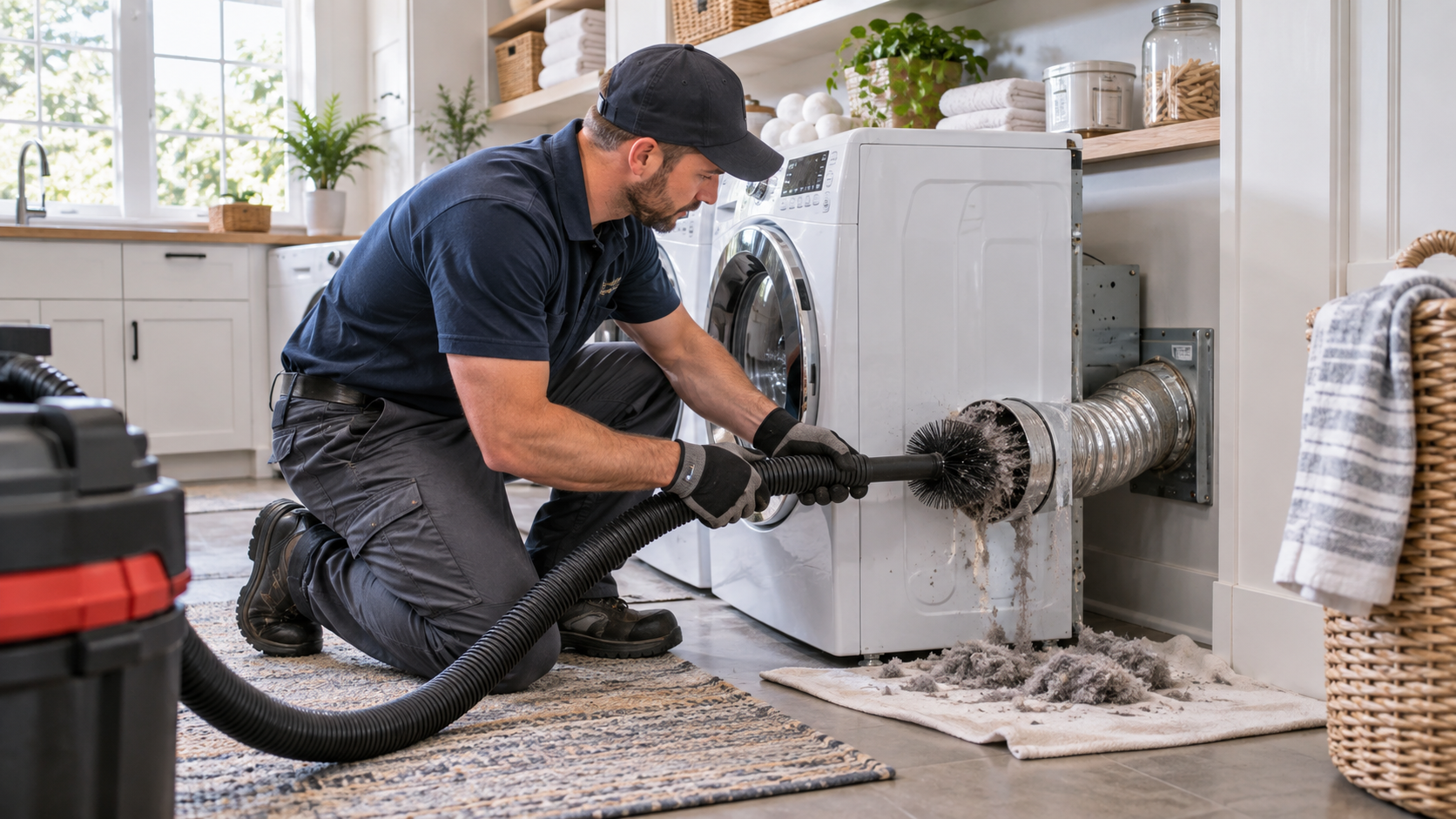
You clean the lint screen after every load. The dryer starts normally. Clothes still come out warm. So everything must be fine, right?
Not always.
The lint filter catches a lot, but it does not catch every fiber that moves through the machine. Small amounts of lint travel into the exhaust duct with hot, moist air. Over months and years, that material can collect along the walls of the vent, around elbows, behind the dryer, and near the exterior vent opening.
At first, you may notice almost nothing.
Then the towels need another 20 minutes. Jeans come out damp around the waistband. The laundry room feels oddly warm. Eventually, one drying cycle becomes two.
That is where laundry dryer vent cleaning comes in.
A proper vent cleaning clears lint and other debris from the duct that carries dryer exhaust from the appliance to the outdoors. It can restore airflow when buildup is causing a restriction, help the dryer operate as intended, and address a maintenance issue connected with dryer fire safety.
The U.S. Consumer Product Safety Commission recommends cleaning lint from the dryer vent pipe at least once a year. Current U.S. Fire Administration data also identifies failure to clean as the leading factor contributing to ignition in home clothes-dryer fires during its 2018-2020 reporting period.
So this is one of those boring household jobs that is actually worth remembering.
How Much Does Laundry Dryer Vent Cleaning Cost in 2026?
For a standard residential dryer vent, professional cleaning is relatively affordable compared with many home-maintenance services.
Current 2026 U.S. pricing puts the average professional dryer vent cleaning at about $145. A typical standard vent often costs around $80 to $185 to clean.
Location matters quite a bit.
A dryer on the first floor with a short vent running directly through an exterior wall may be straightforward. A second-floor laundry room with a long duct traveling through walls and exiting through the roof takes more time and may require special access equipment.
| Service | Typical U.S. Cost | What Affects the Price |
|---|---|---|
| Standard dryer vent cleaning | $80-$185 | Vent length, access, turns, and buildup |
| Basement or first-floor vent | $80-$150 | Usually easier access and shorter vent routes |
| Second-floor dryer vent | $110-$185 | Longer duct or more difficult exterior access |
| Roof dryer vent cleaning | $150-$250 | Roof access, safety equipment, and vertical ductwork |
| Vent cleaning with bird nest removal | $120-$250 | Location and size of the obstruction |
| Dryer vent inspection | $30-$60 | May be included with cleaning by some companies |
| Vent replacement or rerouting | $140-$600+ | Duct length, route, wall access, and materials |
These are national planning ranges. Labor prices in New York City, Seattle, Los Angeles, or Boston can be very different from those in a smaller town.
And a heavily blocked vent may cost more than a routine annual cleaning.
What Exactly Is the Dryer Vent?
People sometimes use “dryer vent” to describe the short silver hose behind the appliance.
That is only one part of the system.
The dryer vent begins at the dryer exhaust outlet and continues through ductwork until it reaches an exterior termination on a wall or roof.
In a simple laundry room, that path may be only a few feet long.
In another house, it may travel 20 or 30 feet behind drywall, across a ceiling, through an attic, and up to the roof.
The longer and more complicated that path becomes, the more places there are for lint to collect.
Bends matter too. Air moving through a straight metal duct has a much easier trip than air moving through several tight 90-degree turns.
Signs Your Dryer Vent May Need Cleaning
You usually do not need to open the wall to figure out that airflow has changed.
The dryer often gives you clues first.
- Clothes suddenly take longer than normal to dry.
- A normal load regularly needs a second drying cycle.
- Clothes feel unusually hot when the cycle ends.
- The exterior of the dryer becomes hotter than you remember.
- The laundry room feels unusually warm or humid during operation.
- You smell something hot, musty, or slightly burned while the dryer runs.
- Lint appears behind or around the dryer.
- The exterior vent flap barely opens when the dryer is operating.
- Airflow from the outside vent feels noticeably weak.
- Your dryer displays a vent or airflow warning.
Longer drying time is probably the most common clue.
If a load that always took 45 minutes now takes 75, something changed.
That does not prove the vent is clogged. Heating elements fail. Gas ignition systems can develop problems. Moisture sensors can malfunction. A washing machine that stops spinning properly can also send unusually wet clothes into the dryer.
But airflow is certainly worth checking.
Why Does Lint Build Up If You Clean the Filter?
A good lint screen captures a huge amount of material.
It still does not capture every fiber.
Tiny particles can pass through the filter and enter the exhaust system. Over time, those fibers can cling to duct walls and collect around connections and bends.
Pet hair can add to the problem. So can dust and fabric fibers from blankets, towels, fleece clothing, and bedding.
Then moisture enters the equation.
A dryer is moving warm, humid air through the vent. That moisture can help loose lint stick to surfaces rather than simply blowing outside.
This is why cleaning the lint filter and cleaning the exhaust duct are two separate maintenance tasks.
Why Dryer Vent Cleaning Is a Fire-Safety Issue
Lint is combustible.
A dryer creates heat.
And restricted airflow can allow temperatures to rise inside a system that is already designed to run hot.
That combination is why dryer maintenance appears repeatedly in federal fire-safety guidance.
The U.S. Fire Administration reports that failure to clean accounted for 31% of the factors contributing to ignition in home clothes-dryer fires during 2018-2020.
The Consumer Product Safety Commission has also estimated an annual average of roughly 6,400 clothes-dryer fires, resulting in about 180 injuries and approximately $105 million in property damage.
Those numbers do not mean every dirty vent is minutes away from catching fire.
They mean lint accumulation is a known and preventable risk.
Cleaning the lint screen and keeping the exhaust path open are basic parts of dryer maintenance, not optional cosmetic chores.
How Often Should a Dryer Vent Be Cleaned?
Once a year is a sensible baseline for many U.S. homes.
The CPSC specifically recommends cleaning lint out of the vent pipe at least annually.
But your dryer does not know what month it is.
A household running two loads of laundry per week through a short straight vent may accumulate lint much more slowly than a family running 12 loads through a long roof vent.
Usage matters.
Vent design matters.
Pets matter.
If drying time begins increasing six months after the last cleaning, there is no reason to wait another six months just because your annual reminder has not appeared yet.
Some Homes May Need More Frequent Cleaning
A yearly service is a starting point, not a law of physics.
Large families tend to run more laundry. More laundry means more lint traveling through the system.
Pet households can also generate impressive amounts of hair and fibers, especially when pet bedding gets washed frequently.
Long vents deserve closer attention too.
A short duct through an exterior wall has relatively little surface area. A long vent with four bends offers far more opportunities for buildup.
And roof vents are naturally more difficult to inspect casually from the ground.
What Happens During Professional Dryer Vent Cleaning?
A typical appointment often takes around 30 to 60 minutes. Complicated ducts or large obstructions can take longer.
The technician normally begins by identifying the vent path and exterior termination.
The dryer may be moved away from the wall so the short transition duct can be inspected. This area deserves attention because flexible connectors can become crushed when an appliance is pushed too close to the wall.
The technician then accesses the vent and runs specialized cleaning equipment through the duct.
Rotary brushes, flexible rods, compressed air, vacuum equipment, or a combination of tools may be used depending on the system.
The goal is to loosen lint from the interior surfaces and remove it from the exhaust path.
Afterward, the system is reconnected and the dryer may be operated while airflow is checked at the exterior termination.
If airflow remains weak after cleaning, the technician may look for crushed ducts, disconnected sections, improper routing, damaged exterior vents, or another problem.
Cleaning Is Not the Same as Repairing the Vent
This distinction matters.
Cleaning removes lint and debris.
It does not repair bad ductwork.
If the exhaust duct is crushed behind the dryer, separated inside a crawl space, badly sagging, or routed through too many tight turns, another cleaning may only provide temporary improvement.
Sometimes rerouting is the smarter fix.
Current 2026 national data puts many dryer vent installation and replacement projects around $140 to $600, with approximately $200 as a national average for ordinary work.
A complicated route through ceilings or walls can cost more.
Paying to correct a bad vent once may be cheaper than paying someone to clear the same restriction every six months.
DIY vs. Professional Laundry Dryer Vent Cleaning
You can buy a dryer vent brush kit for about $15 to $50.
And for the right house, DIY cleaning can be perfectly reasonable.
| Situation | DIY Cleaning | Professional Cleaning |
|---|---|---|
| Short, straight vent through an exterior wall | Often manageable | Optional if you prefer convenience |
| Long hidden duct | More difficult | Usually easier to clean thoroughly |
| Several 90-degree turns | Brushes can be difficult to navigate | Specialized equipment helps |
| Roof termination | May involve unsafe access | Usually the better option |
| Heavy lint blockage | Possible but time-consuming | Professional equipment may work faster |
| Bird or animal nest | Not always straightforward | May require safe removal and inspection |
| Recurring airflow problems | May only treat the symptom | Inspection can reveal routing or duct damage |
If you can see the entire duct and it runs only a few feet, there is much less mystery involved.
If the duct disappears into a wall and comes out two stories higher on the roof, the job becomes much less attractive as a Saturday experiment.
Be Careful With Rotary DIY Brush Kits
Those long flexible brush kits that attach to a drill can work well.
They can also create a new problem when used carelessly.
If sections are not securely connected, a brush head or rod can come apart inside the duct.
Now you have lint plus part of a cleaning kit stuck behind the wall.
Also avoid forcing equipment through sharp bends.
The point is to clean the vent, not remodel it from the inside.
Check the Exterior Vent While the Dryer Runs
Here is a simple check that takes less than a minute.
Start the dryer, then walk outside and find the vent termination.
The exterior flap should open while the machine is operating. You should feel warm exhaust air coming out.
If the flap barely moves or airflow seems much weaker than it used to be, something may be restricting the system.
CPSC safety guidance specifically recommends making sure the exhaust vent pipe is not restricted and that the outdoor vent flap opens when the dryer operates.
This little check will not tell you exactly how much lint is inside the duct.
But it can tell you when something clearly is not right.
Roof Dryer Vents Are a Different Animal
A wall vent is easy to look at.
A roof vent usually is not.
That is one reason roof dryer vent cleaning tends to cost more – commonly around $150 to $250.
The cleaner may need ladders, roof access, fall-protection equipment, or tools long enough to work safely from another access point.
Vertical ducts can also accumulate lint differently from short horizontal runs.
If your laundry room is in the center of an upper floor and you have never seen a dryer vent outside at ground level, there is a good chance the termination may be on the roof.
Bird Nests Can Block Dryer Vents
A warm protected opening on the outside of a house can look like prime real estate to birds and small animals.
Nesting material can restrict the vent very quickly.
You may notice scratching sounds, loose grass or twigs near the vent, weak airflow, or an exterior flap that no longer moves normally.
Bird nest removal with dryer vent cleaning commonly runs around $120 to $250.
But active bird nests can involve wildlife regulations, depending on the species and situation. Do not automatically pull apart an occupied nest without checking what rules apply.
After appropriate removal, a properly designed exterior cover can help discourage another tenant from moving in.
Just make sure the guard itself does not become a lint trap.
What Kind of Dryer Duct Should You Have?
For normal dryer exhaust, metal ducting is the standard direction.
Rigid or appropriate semi-rigid metal offers a smoother interior than flexible foil-style material and generally gives lint fewer places to catch.
The exact installation needs to follow the dryer’s manufacturer instructions and local building requirements.
The short transition connection behind the machine deserves special attention.
If it becomes crushed when the dryer is pushed backward, airflow can drop even when the rest of the duct is perfectly clean.
After moving the appliance, look behind it before calling the job finished.
Gas Dryers Need Proper Exhaust Too
With a gas dryer, the exhaust system carries more than heat and moisture.
Combustion products also need to be vented outdoors properly.
That makes a damaged, disconnected, or badly restricted vent particularly important to address.
If you smell gas or a carbon monoxide alarm activates, that is not a normal dryer vent cleaning question. Follow emergency guidance from your gas utility or local authorities.
Homes with fuel-burning appliances should also have functioning carbon monoxide alarms installed according to current safety guidance and local requirements.
Does Cleaning the Vent Make the Dryer More Efficient?
It can, when restricted airflow is what has been extending your drying cycles.
A dryer removes moisture from clothing and sends that moist air outside.
If exhaust air cannot leave efficiently, drying can take longer.
Imagine running a dryer for 80 minutes to accomplish what used to take 50 minutes. That extra operating time means more energy use.
Clear the restriction, and drying time may return closer to normal.
But be careful with companies promising a specific 30%, 40%, or 50% reduction in your utility bill without knowing anything about your appliance or vent.
Actual savings depend on how badly the vent was restricted, your dryer type, energy prices, load size, and how often you do laundry.
What If Clothes Still Take Forever After Cleaning?
Then the vent may not have been the real problem.
That is useful information too.
An electric dryer can develop a faulty heating element. A gas dryer may have burner or ignition trouble. Temperature sensors and moisture sensors can fail.
A washer can also leave clothes much wetter than normal when its spin cycle is not working correctly.
And oversized loads take longer regardless of vent condition.
If airflow at the exterior termination is strong after cleaning but drying performance remains poor, appliance diagnosis makes more sense than cleaning the same duct again.
How to Prepare for a Professional Cleaning Appointment
You do not need to reorganize the entire laundry room.
Just give the technician reasonable access.
- Clear boxes, baskets, and laundry from around the dryer.
- Make sure the technician can reach the appliance and nearby wall.
- Tell the company in advance if the vent exits through the roof.
- Mention any airflow warnings or unusual dryer behavior.
- Explain if animals or birds may be inside the vent.
- Point out any known duct repairs or unusual routing.
- Keep pets away from the work area if necessary.
- Ask before the visit whether the dryer needs to be disconnected.
A technician who knows beforehand that the vent exits on a second-story roof can arrive with the right equipment instead of discovering the surprise after moving the dryer.
How to Choose a Dryer Vent Cleaning Company
This should be a fairly straightforward service, which makes vague pricing especially frustrating.
Before booking, ask whether the quote covers the entire exhaust path from the dryer to the outdoor termination.
Some companies charge more for long ducts, roof access, animal nests, severe blockages, or inspection.
That is fine – as long as you know before the job begins.
- Ask for an estimated total price rather than only a promotional starting price.
- Confirm whether roof or second-story access costs extra.
- Ask whether moving and reconnecting the dryer is included.
- Find out whether the exterior vent is inspected.
- Ask what happens if the technician finds damaged or disconnected ductwork.
- Check whether the company carries appropriate insurance.
- Ask whether repairs are quoted separately before work begins.
- Read recent local reviews rather than relying only on national advertising.
A cheap advertisement is not automatically a bad deal.
But a $39 promotion that becomes $300 after the technician arrives is not much of a bargain.
Dryer Vent Cleaning and Air Duct Cleaning Are Different Services
The terminology causes confusion.
Your HVAC air ducts circulate heated and cooled air around the home.
Your dryer vent carries hot, moist dryer exhaust directly outside.
They are separate systems.
A company may offer both services, but needing one does not mean you automatically need the other.
If someone tells you that a clogged dryer vent proves the entire HVAC duct system needs cleaning, ask them to explain the connection.
Common Mistakes That Make Dryer Vent Problems Worse
The first is ignoring longer drying times.
People simply add another 20 minutes to every load and assume the dryer is getting old.
Maybe it is. But check airflow before making that assumption.
Another mistake is pushing the dryer tight against the wall and crushing the transition duct.
Then there is the exterior vent.
A cover that is blocked with lint or nesting material can restrict the entire system even when the indoor duct is fairly clean.
And finally, do not run the dryer without its lint screen because you think it will improve airflow.
It gives lint a much easier route into the exhaust system.
When Should You Stop Using the Dryer?
A slightly slower load does not necessarily require shutting everything down immediately.
But some signs deserve more caution.
If you smell something burning, notice smoke, see unusual overheating, hear abnormal electrical sounds, or discover that exhaust cannot leave the vent at all, stop running the appliance until the problem is checked.
If a gas dryer produces a gas odor, leave the area when appropriate and follow the gas utility’s emergency instructions.
When in doubt, a load of wet towels can wait.
FAQ
How much does laundry dryer vent cleaning cost in 2026?
Professional dryer vent cleaning averages about $145 nationally. Standard vents commonly cost around $80 to $185, while roof vents often cost approximately $150 to $250. Long ducts, difficult access, severe buildup, and animal nests can increase the price.
How often should a laundry dryer vent be cleaned?
At least once a year is a good baseline for many households and matches current CPSC safety guidance. Heavy dryer use, long ducts, pets, several bends, or recurring airflow problems may justify more frequent inspection or cleaning.
How do I know whether my dryer vent is clogged?
Watch for longer drying times, unusually hot clothing, a hot laundry room, weak outdoor exhaust airflow, a vent flap that barely opens, excess lint around the dryer, burning odors, or airflow warnings from the appliance.
Can I clean my own dryer vent?
Yes, especially when the duct is short, straight, and easy to access. Long concealed ducts, roof vents, several bends, heavy obstructions, or recurring problems are generally better candidates for professional equipment.
Can a clogged dryer vent cause a house fire?
Lint accumulation and poor dryer maintenance are recognized fire hazards. U.S. Fire Administration data identifies failure to clean as the leading factor contributing to ignition in home clothes-dryer fires during 2018-2020.
How long does professional dryer vent cleaning take?
A normal residential cleaning commonly takes about 30 to 60 minutes. Severe lint buildup, long ducts, roof access, nests, or damaged ductwork can extend the appointment.
Will dryer vent cleaning make clothes dry faster?
It can if restricted airflow is responsible for the longer drying time. If airflow is already good, slow drying may come from the appliance, washer spin performance, oversized loads, heating problems, or another issue.
Conclusion
Laundry dryer vent cleaning is easy to forget because almost all of the important parts are hidden.
The lint screen is right in front of you. You see it every time you open the dryer.
The exhaust duct disappears into a wall and asks for nothing.
Until it does.
Longer drying cycles, unusually hot clothing, weak outside airflow, or a vent flap that barely opens are all worth noticing.
For most households, annual cleaning is a sensible baseline. Current CPSC guidance specifically recommends removing lint from the dryer vent pipe at least once a year, and current fire data gives homeowners a pretty good reason not to ignore the job.
Professional service is relatively inexpensive by home-maintenance standards. In 2026, the average sits around $145, while many normal jobs cost about $80 to $185.
If your vent exits through the roof, expect to pay more. If there is a bird nest, several sharp bends, a very long run, or damaged ductwork, the job can become more involved.
And remember that cleaning is only part of the picture.
Keep the lint screen clean. Do not crush the transition duct behind the appliance. Make sure the exterior vent opens when the dryer runs. Pay attention when drying times change.
If the vent repeatedly clogs, ask why.
A poor duct route, damaged section, unnecessary bends, or exterior obstruction may need repair rather than another round of cleaning.
A properly working dryer vent is not exciting.
That is exactly the point.
You put wet laundry into the machine. Warm, moist air leaves the house. Clothes dry in roughly the time you expect, and you do not think about the duct hidden behind the wall.
Sometimes the best home maintenance is the kind you barely notice after it is done.
Leave a Reply