Carpet has an annoying talent. It can look perfectly fine for months, and then one sunny afternoon makes every stain, traffic path, crumb, and mysterious dark patch suddenly visible.
Vacuuming helps, of course. It removes loose dirt, hair, dust, and whatever the kids carried inside on their shoes. But eventually, dirt settles deeper into the pile, spills leave residue, and the carpet starts looking tired even after a very enthusiastic vacuuming session.
That is where professional carpet cleaners come in.
In 2026, the average professional carpet-cleaning job in the U.S. costs around $183, with many homeowners paying roughly $123 to $242. Individual rooms commonly run about $40 to $125, although the final bill depends on the carpet, cleaning method, square footage, stains, furniture, and where you live.
The Carpet and Rug Institute recommends professional deep cleaning about every 12 to 18 months for many residential carpets. Some homes need it more often. A household with two dogs, three kids, and a light beige living-room carpet is playing a different game from a one-person apartment where shoes come off at the door.
Still, price is only part of the decision.
Carpet cleaners use different methods. Some companies include pre-vacuuming and spot treatment. Others charge for them. Some quotes cover furniture moving; some absolutely do not.
So before booking the first $59 special you see online, it helps to know what you are actually paying for.
How Much Do Carpet Cleaners Cost in 2026?
There is no single national price because carpet-cleaning jobs vary wildly.
A lightly used bedroom with no stains may take little time. A family room with pet accidents, food spills, a sectional sofa, and five years of foot traffic is another project entirely.
Current U.S. pricing data puts many professional jobs between about $123 and $242, with an average near $183. Per-room rates commonly fall between $40 and $125. Some carpet cleaners price by square footage instead, often around $0.25 to $0.50 per square foot for standard work.
| Carpet Cleaning Service | Typical 2026 U.S. Cost | What Affects the Price |
|---|---|---|
| Average professional cleaning job | About $123-$242 | Home size, carpet type, method, soil level |
| Basic cleaning per room | About $40-$125 | Room size and cleaning method |
| Cleaning per square foot | About $0.25-$0.50 | Total area and minimum service charge |
| Typical 3-bedroom home | About $200-$500 | Number of carpeted rooms and hallways |
| Large home | About $300-$700+ | Six or more rooms, stairs, extra treatments |
| Furniture moving | Often $25-$75 per room extra | Size, weight, and number of pieces |
| Pet odor treatment | Often $20-$40+ per room | Severity and depth of contamination |
Small jobs may have a minimum charge.
So even if one tiny bedroom technically works out to $40 based on square footage, a company may have a $100 or $150 service minimum.
This is normal. A technician still has to drive to your home, unload equipment, set everything up, clean, pack the equipment again, and travel to the next job.
Why One Carpet Cleaning Quote Can Be Twice Another
You call one company and hear $149.
The next says $285.
The third confidently announces $89 and somehow ends up at $320 when the technician reaches your living room.
Fun.
The difference often comes down to what is included.
One company may include vacuuming, pre-treatment, basic spot treatment, hot water extraction, and light furniture moving. Another price may cover only the cleaning itself.
Ask for the complete expected price before the appointment whenever possible.
And tell them about stains, stairs, pets, wool carpet, oversized rooms, and furniture when requesting the estimate. A quote based on three empty 150-square-foot rooms is not useful if you actually have a 500-square-foot family room with a sectional and two dogs.
Signs It May Be Time to Call Carpet Cleaners
You do not need to wait until the carpet looks gray.
Deep cleaning works best as maintenance, not as a desperate final attempt to save flooring that has been neglected for a decade.
- Vacuuming no longer makes the carpet look noticeably fresher.
- High-traffic paths appear darker than the rest of the room.
- Spots keep returning after DIY cleaning.
- The carpet has a stale or musty odor.
- Pet odors remain after ordinary spot cleaning.
- Light-colored carpet has become dull or uneven in tone.
- The carpet has not been professionally cleaned in 12 to 18 months.
- You are preparing the home for sale or move-out.
- Children or pets spend a lot of time directly on the carpet.
- Your carpet warranty requires periodic professional cleaning.
That last point is easy to overlook.
Some carpet manufacturers have specific maintenance requirements. If your carpet is still under warranty, check the paperwork before hiring someone or renting a machine.
How Often Should Carpets Be Professionally Cleaned?
The Carpet and Rug Institute recommends professional deep cleaning roughly every 12 to 18 months.
That is a useful baseline, not a deadline carved into stone.
A low-traffic guest bedroom can probably go longer than an entryway or family room. Homes with pets, children, allergy concerns, heavy foot traffic, or frequent spills may benefit from cleaning every 6 to 12 months.
Regular vacuuming still matters between professional visits.
Deep cleaning should not become an excuse to ignore weekly maintenance. Dry soil is easier to remove with a vacuum before it becomes ground deep into carpet fibers.
Hot Water Extraction: The Method Most People Call Steam Cleaning
When homeowners say “steam cleaning,” they usually mean hot water extraction.
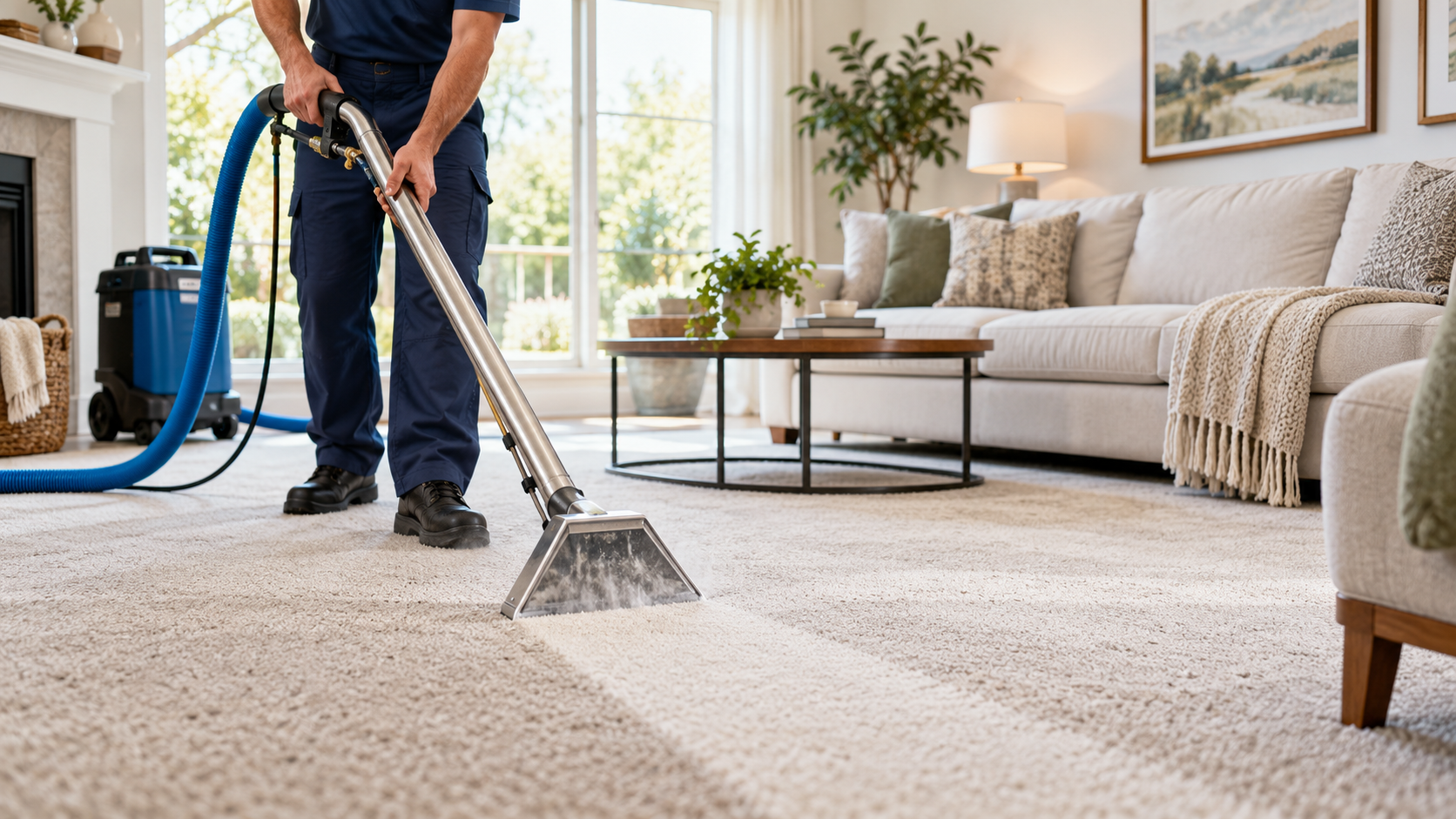
The machine applies cleaning solution and hot water to the carpet, then extracts the water along with loosened soil.
Truck-mounted systems are common, although portable professional extractors are also used in apartments, high-rise buildings, and locations where truck access is difficult.
Hot water extraction is popular for deep residential cleaning because it can remove embedded soil rather than simply treating the upper surface.
It also works well for many synthetic residential carpets.
There is a tradeoff: drying time.
Depending on the carpet, humidity, airflow, equipment, and amount of moisture used, complete drying can take several hours and sometimes much longer.
A professional should extract as much water as practical rather than leaving the carpet soaked.
Dry Carpet Cleaning: When Fast Drying Matters
“Dry cleaning” is a broad term in carpet care.
Some methods rely on very low moisture, absorbent compounds, or specialized cleaning chemistry rather than saturating the fibers with water.
The big advantage is obvious: faster drying.
This can make sense in offices, commercial areas, rentals, or homes where rooms need to return to use quickly.
Low-moisture systems can also suit certain carpets where heavy wet cleaning is not ideal.
But do not assume dry cleaning is automatically better because it sounds gentler.
The right method depends on fiber type, construction, soil level, stains, and the manufacturer’s care instructions.
How the Main Carpet Cleaning Methods Compare
| Cleaning Method | Typical Cost per Room | Best Fit | Main Consideration |
|---|---|---|---|
| Hot water extraction | About $40-$90 | Deep residential cleaning | Needs drying time |
| Low-moisture / dry cleaning | About $60-$130 | Faster return to use | Method varies by company |
| Carpet shampooing | About $80-$150 | Heavily soiled carpet | Can require more drying and rinsing |
| Bonnet cleaning | About $30-$90 | Commercial surface maintenance | Primarily cleans the upper carpet surface |
| Encapsulation | About $80-$200 | Routine commercial or low-moisture maintenance | Often paired with later vacuuming |
Do not pick a method only because it is the cheapest line in a table.
A good carpet cleaner should inspect the flooring first and explain why the proposed process suits your carpet.
Pre-Vacuuming Is Not a Pointless Extra Step
Here is an easy question to ask carpet cleaners: “Do you vacuum before deep cleaning?”
The Carpet and Rug Institute says the answer should be yes.
Dry soil is better removed while it is still dry.
If sand, dust, hair, and loose debris remain in the carpet when wet cleaning begins, the machine now has to deal with material that could have been removed first with a thorough vacuuming.
Some cleaning companies include pre-vacuuming.
Others expect homeowners to vacuum before the appointment.
Neither arrangement is necessarily wrong. Just find out before the technician arrives.
Will Carpet Cleaners Remove Every Stain?
No.
A professional cleaner should improve many stains. That does not mean every discoloration will disappear.
A stain can involve more than dirt sitting on the surface.
Some substances chemically change the carpet dye. Bleach can remove color. Strong cleaners used during previous DIY attempts can cause permanent discoloration. Certain spills penetrate the backing or pad.
Age matters too.
Fresh coffee is generally a friendlier problem than coffee that has been sitting under a sofa since 2022.
A good technician should set realistic expectations before beginning instead of guaranteeing that every spot will magically vanish.
Why Do Old Stains Sometimes Come Back?
You clean a spot. It disappears.
Two days later, hello again.
This can happen when residue or contamination remains deeper in the carpet or backing and moves upward while the carpet dries. It can also happen when too much cleaning product is left behind and attracts new soil.
This is often called wicking.
Another possibility is simple resoiling.
If sticky detergent residue remains in the fibers, that area can become dirty faster than the surrounding carpet.
More cleaning solution is not always more cleaning.
Proper rinsing and extraction matter.
Pet Urine Is a Different Kind of Carpet Problem
A small fresh pet accident on the surface is one thing.
Repeated urine in the same corner is another.
Urine can pass through the carpet into the pad and, in severe cases, reach the subfloor. At that point, surface cleaning may make the carpet look better without solving the odor underneath.
Professional carpet cleaners may use specialized detection, extraction, rinsing, or odor treatments depending on how serious the problem is.
Ask exactly what a pet treatment includes.
A quick deodorizer sprayed over the carpet is not the same thing as treating contamination in the backing and pad.
Also, heat is not always your friend with fresh urine spots. Carpet-care guidance recommends extracting fresh urine and rinsing appropriately rather than simply attacking it with high heat.
What About Carpet Deodorizers?
Deodorizing can help when odor is coming from material trapped in the carpet.
But fragrance is not odor removal.
If a company solves every odor problem by spraying something that smells like “Mountain Breeze Deluxe,” you may simply have Mountain Breeze mixed with dog odor.
The source needs attention.
Pet contamination, smoke residue, spilled milk, moisture, and mold all require different responses.
A cleaner should diagnose the likely source before recommending an add-on.
A Musty Carpet May Be a Moisture Problem
If carpet smells genuinely musty, investigate moisture rather than simply cleaning over it.
The EPA notes that mold can grow where carpet and padding stay wet. Water-damaged carpet, backing, and padding need to dry quickly – generally within 24 to 48 hours – to reduce the risk of mold growth.
This matters after flooding, plumbing leaks, overflowing appliances, or major water intrusion.
A routine carpet cleaner may not be the right professional for a serious water-damage situation.
If the pad, subfloor, or wall is wet, the project may require water extraction and structural drying rather than a standard cleaning appointment.
Carpet Cleaning After a Flood Is Not Ordinary Cleaning
The source of the water matters.
Clean water from a recent supply-line leak is different from contaminated water from sewage or flooding.
Do not assume a carpet-cleaning machine can make every water-damaged carpet safe again.
Some materials can be dried and restored. Others may need to be removed.
If sewage, significant mold, or contaminated floodwater is involved, ask a qualified water-damage or remediation professional rather than treating the situation like a spilled glass of water.
Wool Carpet Needs Different Care
Wool is beautiful. It is also not inexpensive.
So this is not the ideal surface for experimenting with the strongest bottle under the kitchen sink.
Natural fibers can react differently to moisture, heat, alkalinity, and stain-removal chemicals than common synthetic carpet.
If you have wool, silk blends, or another specialty fiber, tell the company when requesting a quote.
Ask whether the technician has experience cleaning that material.
A slightly higher cleaning price is preferable to discovering afterward that your very expensive carpet now has an exciting new texture.
How Long Does Carpet Take to Dry?
Drying time varies widely.
After hot water extraction, many carpets need several hours. Depending on indoor humidity, temperature, ventilation, pile thickness, and how much water was used, full drying may take anywhere from roughly 6 to 24 hours.
Low-moisture methods can dry much faster.
Fans and air conditioning can help move moisture out of the room.
Follow the cleaner’s instructions before replacing furniture or walking heavily on the carpet.
And if a supposedly routine professional cleaning leaves the carpet truly wet the next day, call the company.
Should Carpet Cleaners Move the Furniture?
Maybe.
Some companies move lightweight chairs, small tables, and similar pieces as part of the service.
Heavy furniture may cost extra or may not be moved at all.
Large beds, entertainment centers, antique furniture, pianos, electronics, and delicate pieces often remain in place.
Ask before the appointment.
Also decide whether you actually need carpet cleaned under furniture that has not moved in 12 years and probably will not move for another 12.
Sometimes cleaning the exposed traffic areas is enough.
How to Prepare Before Carpet Cleaners Arrive
A little preparation helps the technician spend more time cleaning and less time moving your belongings.
- Pick up toys, shoes, clothing, cables, and small objects from the floor.
- Vacuum thoroughly if pre-vacuuming is not included.
- Move fragile or valuable decorations yourself.
- Remove lightweight furniture if you want the carpet beneath it cleaned.
- Point out stains and explain what caused them when you know.
- Tell the technician about previous cleaning products used on problem areas.
- Secure pets in another room or safe area.
- Clear a convenient path between the entrance and carpeted rooms.
- Reserve nearby parking if the cleaner uses truck-mounted equipment.
- Ask how long the carpet should dry before normal use.
You do not need to deep-clean your house before the carpet cleaner arrives.
You are allowed to let the professional see dirt. That is rather the point.
Professional Carpet Cleaning vs. Renting a Machine
Renting a carpet-cleaning machine can save money.
A standard rental often costs around $30 to $50 per day, while more powerful machines can cost more.
For one small room with ordinary dirt, DIY cleaning can make sense.
Professionals bring several advantages, though.
They have stronger extraction equipment, more experience identifying carpet fibers and stains, and access to products designed for specific problems.
They are also less likely to leave the carpet overly wet.
That last part matters.
One of the common DIY mistakes is using far too much solution and not extracting enough water. The room smells fresh for an afternoon, then the carpet feels sticky and takes forever to dry.
Do You Need Carpet Protector After Cleaning?
Many carpet cleaners offer a protective treatment after cleaning.
These products are designed to make some spills easier to blot and slow the rate at which soil bonds to fibers.
Whether the add-on makes sense depends on your carpet and household.
A pale family-room carpet in a home with children may benefit more than a dark guest-room carpet used twice a year.
Check what product is being applied and whether it is suitable for the carpet manufacturer and fiber type.
Do not buy the add-on solely because someone says your carpet will be ruined without it.
Carpet Cleaning Before Selling a Home
This is one of the easiest times to justify professional cleaning.
Replacing carpet can cost thousands.
Cleaning costs a fraction of that.
If the carpet is structurally sound but simply looks dull, a deep cleaning can make rooms appear fresher for listing photographs and showings.
It can also help with ordinary household odors that homeowners stop noticing after living with them every day.
But know when the carpet is past saving.
Cleaning will not repair torn seams, bald areas, severe sun fading, permanent bleach marks, or padding that has broken down underneath.
Carpet Cleaning in Rentals
Renters often book carpet cleaners before moving out, especially when the lease contains cleaning requirements.
Read the lease first.
Some landlords require professional cleaning. Others simply expect the unit returned reasonably clean. State laws and lease rules differ, so do not assume that a carpet-cleaning charge is automatically required everywhere.
If professional cleaning is required, keep the receipt.
And take photographs after the work is completed.
How to Spot a Suspicious Carpet Cleaning Deal
A low price is not automatically a scam.
But extremely cheap advertising deserves a second look.
“Three rooms for $49” sounds fantastic until the company explains that normal pre-treatment, extraction, deodorizing, stain treatment, hallway cleaning, and breathing near the machine are all additional charges.
Ask what the advertised rate actually covers.
The Carpet and Rug Institute also warns homeowners to be careful with simplistic per-room pricing because room sizes vary dramatically.
A 90-square-foot bedroom and a 450-square-foot great room are not the same job.
Questions to Ask Carpet Cleaners Before Hiring
- Do you price by room, square foot, or total job?
- What exactly is included in the quoted price?
- Do you pre-vacuum before deep cleaning?
- Which cleaning method do you recommend for my carpet and why?
- Are stain treatments included or charged separately?
- How do you handle pet urine or odor problems?
- Do you move furniture, and does that cost extra?
- How long should the carpet take to dry?
- Are your technicians trained or certified by a recognized industry organization?
- Does your work meet my carpet manufacturer’s warranty requirements?
A good cleaner should be able to answer these questions without turning the conversation into a sales performance.
Is IICRC Certification Worth Looking For?
The Institute of Inspection, Cleaning and Restoration Certification, or IICRC, develops standards and certification programs used in the cleaning and restoration industry.
Certification does not guarantee that every technician will be perfect.
It does show that a company or technician has made some effort to follow recognized training and technical standards.
The Carpet and Rug Institute specifically suggests asking whether technicians hold IICRC certification when hiring carpet cleaners.
Experience still matters too.
The person who has cleaned thousands of residential carpets and can explain exactly why your wool rug needs different treatment from your polyester bedroom carpet is usually more reassuring than someone who simply says, “We use the strongest machine.”
Are Carpet Cleaners Worth the Money?
For many households, yes.
Not because professional cleaning makes carpet immortal.
It does not.
But carpeting is expensive to replace, and routine maintenance is considerably cheaper.
A professional cleaning can remove embedded soil, improve appearance, address many common stains, and freshen carpet that no longer responds well to ordinary vacuuming.
It can also save you several hours of wrestling with a rental machine while wondering why one corner is now wetter than the Pacific Northwest.
Still, not every job needs a professional.
If one small bedroom needs a basic refresh and you already know how to use an extractor correctly, DIY may be perfectly reasonable.
Use professionals where their equipment and experience actually add value.
FAQ
How much do carpet cleaners cost in 2026?
The average professional carpet-cleaning job is around $183, with many projects falling between roughly $123 and $242. Individual rooms commonly cost about $40 to $125, while square-foot pricing often runs around $0.25 to $0.50.
How often should carpets be professionally cleaned?
The Carpet and Rug Institute recommends professional deep cleaning roughly every 12 to 18 months. Homes with pets, children, heavy traffic, frequent spills, or certain warranty requirements may need cleaning more often.
What carpet cleaning method is best?
There is no single best method for every carpet. Hot water extraction is common for deep residential cleaning, while low-moisture methods can be useful when fast drying or specific carpet construction makes less water desirable. Fiber type and manufacturer instructions matter.
How long does carpet take to dry after professional cleaning?
After wet extraction, full drying commonly takes several hours and may take roughly 6 to 24 hours depending on humidity, airflow, carpet thickness, equipment, and how much moisture was used. Low-moisture cleaning can dry much faster.
Can carpet cleaners remove pet urine smells?
Many pet odors can be improved or removed, but severe urine contamination may extend into the carpet backing, pad, or subfloor. In those cases, ordinary surface cleaning may not be enough and deeper treatment or material replacement may be needed.
Should I vacuum before carpet cleaners arrive?
Yes, unless pre-vacuuming is included in the service. Removing loose dry soil before deep cleaning improves the process. Confirm with the company when booking because service packages vary.
Can professional carpet cleaning remove every stain?
No. Many stains respond well to professional treatment, but permanent dye loss, bleach damage, old chemical reactions, severe discoloration, and some deeply absorbed spills cannot always be reversed. A reputable cleaner should explain realistic expectations before starting.
Conclusion
Hiring carpet cleaners should not feel mysterious.
You have carpet. It gets dirty. Eventually, a vacuum is no longer enough.
Professional cleaning costs around $183 on average in 2026, although plenty of jobs fall above or below that number. Room size, square footage, fiber type, cleaning method, stairs, furniture, pet treatments, stains, and local labor costs all matter.
The simplest comparison is not just price.
Ask what the price includes.
Does the company vacuum first? Are common stains pre-treated? Is furniture moving extra? What method will they use? How long should the carpet take to dry?
Then pay attention to the carpet itself.
Synthetic residential carpet may be a straightforward hot water extraction job. Wool and specialty fibers deserve more careful treatment. Pet urine may need work below the surface. A musty carpet may point to moisture rather than ordinary dirt.
And if carpet has been wet after a leak or flood, drying becomes more important than making it smell nice. Carpet, backing, and padding need to dry quickly; persistent moisture can turn a cleaning issue into a mold problem.
For normal maintenance, the Carpet and Rug Institute’s 12-to-18-month professional cleaning recommendation is a useful starting point.
You may need it sooner.
You may not.
A clean, low-traffic guest room does not care what the calendar says.
What matters is developing a routine that keeps dirt from becoming part of the carpet permanently.
Vacuum regularly. Deal with spills while they are fresh. Keep outdoor dirt at the door. Deep clean when the carpet needs it.
And when the time comes to hire carpet cleaners, find someone who can explain the process instead of simply promising that their machine is “the most powerful in town.”
Your carpet does not need a dramatic sales pitch.
It needs the right cleaning method, proper extraction, enough drying time, and someone who knows what they are looking at.
That is usually enough to make the room feel surprisingly new again.
Leave a Reply