A fireplace mantel is a funny little space.
It is usually narrow, highly visible, and somehow expected to carry the personality of an entire room. Add too little and it can look forgotten. Add too much and suddenly the mantel resembles the clearance shelf of a home decor store.
The sweet spot sits somewhere in between.
Good mantel decor does not require a giant shopping trip or a perfectly symmetrical row of expensive objects. In fact, some of the most interesting mantels use things people already own: a framed print, one ceramic vase, a stack of books, a branch from the backyard, and maybe a candle or two.
The trick is getting the proportions right.
In 2026, the strongest decorating direction is less about filling every inch and more about creating a mantel that feels personal, layered, and relaxed. Think texture instead of clutter. Warm materials instead of perfectly matched sets. One large anchor instead of twelve tiny objects fighting for attention.
And yes, you can still decorate seasonally without rebuilding the whole thing every three months.
Start With One Main Piece
The easiest way to decorate a mantel is to decide what gets to be the star.
Usually that is a mirror, painting, framed photograph, sculptural object, or television.
If there is no main focal point, the eye bounces from one small item to another. That is often why a mantel looks busy even when there are not actually that many objects on it.
A large piece gives everything else something to work around.
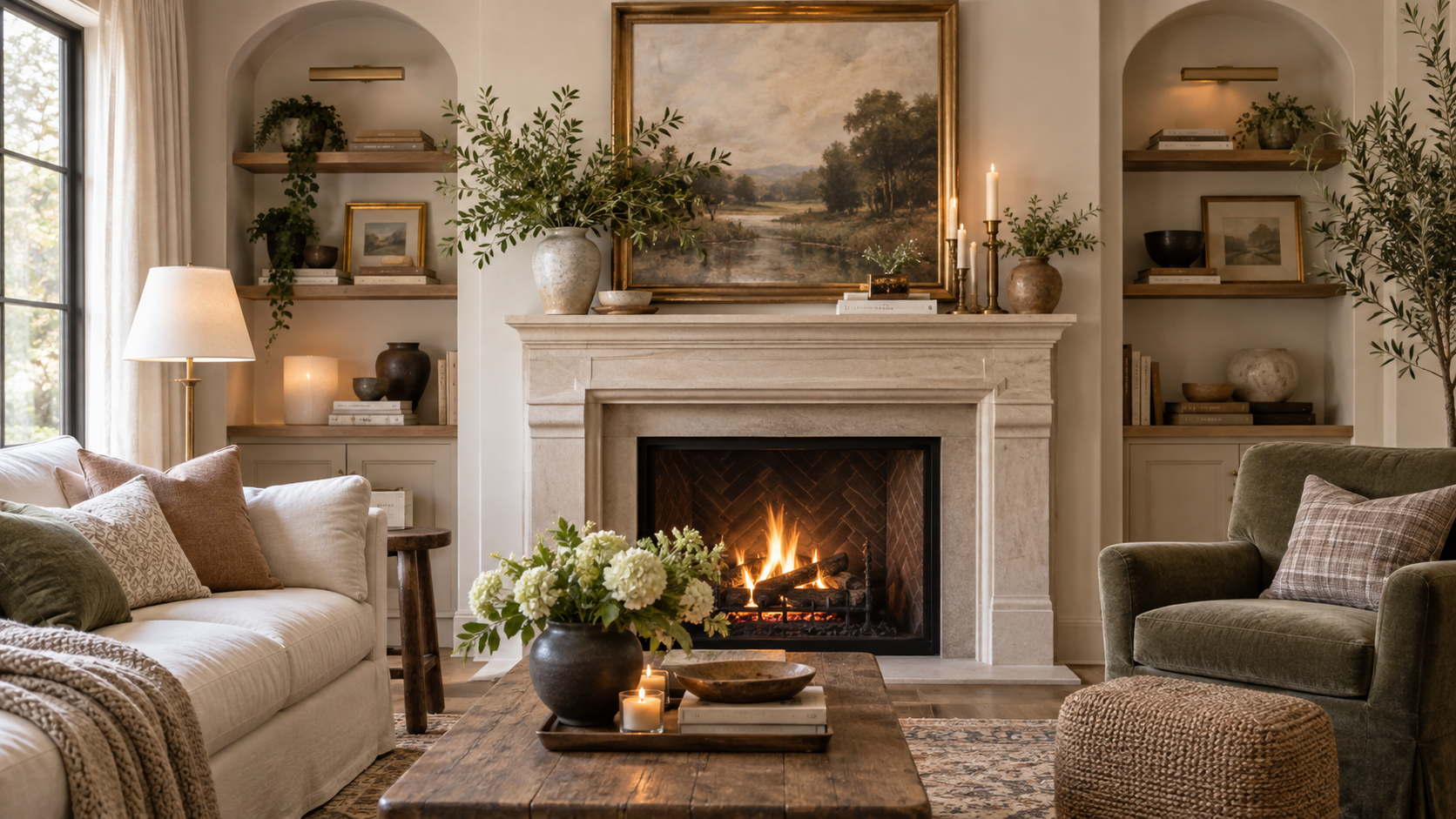
For a traditional room, that could be a framed landscape or vintage mirror. In a modern living room, maybe it is an oversized abstract print. For a softer organic look, a simple round mirror with a wood, black, or aged-brass frame can do most of the heavy lifting.
And the focal point does not have to be centered.
Leaning a large framed piece slightly off-center and layering smaller objects in front can make the whole setup feel more casual.
How Big Should Mantel Art Be?
There is no single magic measurement, because fireplace widths vary so much.
But scale matters.
A tiny 8-by-10-inch print floating above a six-foot fireplace usually looks lost. On the other hand, a piece that nearly reaches both outer edges of the mantel can feel cramped.
A good starting point is to let your main artwork or mirror occupy roughly half to two-thirds of the visual width above the fireplace.
It does not need to match the mantel width exactly.
You want breathing room around it.
| Mantel Width | Good Starting Size for Main Decor | What Usually Works |
|---|---|---|
| Under 48 inches | About 20-30 inches wide | Single framed artwork, round mirror, small gallery cluster |
| 48-60 inches | About 28-40 inches wide | Medium mirror, large artwork, layered frames |
| 60-72 inches | About 36-48 inches wide | Oversized print, substantial mirror, sculptural focal piece |
| Over 72 inches | About 40-55 inches wide | Large art, wide mirror, larger layered arrangement |
These are decorating ranges, not rules.
If a piece looks right to your eye, you do not need to pull out a calculator to defend it.
Symmetry Is Easy. Asymmetry Is More Interesting.
Perfect symmetry is a safe approach.
Place a mirror in the center, one matching candleholder on each side, and you are basically done.
It works especially well in formal, traditional, and transitional rooms.
But an asymmetrical mantel often feels more current and personal.
You might place a tall vase on the left, then balance it with two shorter objects and a stack of books on the right.
The objects are not identical, but their visual weight feels balanced.
That is the important part.
Imagine the mantel like a seesaw. You do not need matching objects on both ends. You just need both sides to feel like they belong in the same composition.
The Rule of Different Heights
One of the fastest ways to make mantel decor look flat is to line up objects that are all the same height.
Instead, create a few levels.
A tall vase can sit behind a small framed photograph. A stack of two books can raise a ceramic bowl. Candlesticks can vary slightly in height rather than forming a rigid row.
The eye naturally moves through the arrangement instead of stopping at one horizontal line.
Try thinking in three zones:
- A tall element that gives the arrangement height
- A medium object that connects the tall piece to the mantel
- A lower object that keeps the composition grounded
You do not need three objects on each side.
Sometimes those three height levels can be created across the entire mantel using only four or five pieces total.
Do Not Decorate Every Inch
Empty space is part of the design.
This sounds obvious, but mantel decorating tends to trigger an odd instinct: “There is a free six-inch spot. Something must go there.”
No.
Let it stay empty.
Negative space helps the pieces you actually like stand out. It also keeps a fireplace from feeling visually heavy, especially if the room already has bookshelves, patterned rugs, artwork, or lots of furniture.
If the mantel feels cluttered, the solution is usually subtraction.
Take two things away before adding another.
Easy Mantel Decor Formula for Beginners
If you have no idea where to start, use this simple formula:
- One large mirror or artwork as the anchor
- One tall object such as a vase, branch, or candlestick
- One medium decorative object
- One small group of two or three related pieces
- Optional greenery or seasonal material
That is enough for most mantels.
The small group might be two ceramic vessels. Or three short candles. Or a book stack with a small object on top.
Do not worry about matching everything.
Related is better than identical.
Use Books to Fix Awkward Heights
Books are one of the best tools in mantel decor because they do something decorative objects cannot always do: they change height instantly.
A small sculpture that looks lost on its own can suddenly feel intentional when placed on two stacked hardcover books.
Old art books, travel books, design books, cookbooks, and vintage hardcovers all work.
You can turn the spines outward if they suit the room or rotate the books so the page edges face forward for a quieter look.
And you certainly do not need to buy decorative fake books with random Parisian words printed on the spine.
Use books you actually like.
Mirrors: The Mantel Shortcut
If you are unsure what belongs above the fireplace, a mirror is difficult to mess up.
It adds height, reflects light, and works with almost every decorating style.
Round mirrors soften fireplaces built from lots of straight lines. Arched mirrors work beautifully with traditional or European-inspired interiors. Rectangular mirrors feel cleaner and more architectural.
One thing worth checking before you buy: what will the mirror actually reflect?
A beautiful mirror reflecting a blank ceiling vent is slightly less exciting than expected.
Stand where the mirror will go and look at the room from that angle.
Artwork Makes a Mantel Feel More Personal
Art immediately says more about the homeowner than generic decorative accessories do.
You do not need an original oil painting.
Photography, vintage botanical prints, abstract work, family artwork, textile pieces, or a framed sketch can all work.
And leaning art instead of hanging it makes seasonal changes easier.
You can also layer two pieces.
Place one larger frame behind and overlap it slightly with a smaller piece. The result feels collected rather than overly planned.
Just keep the number of layers reasonable.
Three or four frames can work. Twelve usually turn the mantel into a photo-storage solution.
Candles Are Still One of the Easiest Additions
Candles work because they bring height, texture, and warmth without demanding much visual attention.
Mixing candleholders often looks better than buying a matching set.
Try aged brass with ceramic. Black metal with wood. Clear glass beside stone.
The candles themselves can stay simple.
Cream, ivory, soft taupe, and natural beeswax tones work with almost any palette.
If the fireplace is used regularly, though, keep combustible decor well away from heat and open flame. Fireplace construction, mantel clearances, and manufacturer requirements vary, so decorative placement should never interfere with the safe operating clearances specified for your particular fireplace.
Greenery Makes Almost Everything Look Better
If your mantel arrangement feels finished but somehow lifeless, add something organic.
A small leafy branch can be enough.
Other easy options include eucalyptus, olive branches, dried grasses, seasonal stems, or a small trailing plant if the location gets suitable light.
Fresh branches are especially good because they introduce an irregular shape into a space full of straight shelves and frames.
You do not need an enormous flower arrangement.
Sometimes one branch in an interesting vase looks better.
What Materials Look Good Together?
A mantel feels richer when several textures appear together.
If everything is shiny brass, it can look like a display. If everything is white ceramic, objects begin disappearing into one another.
Try mixing two or three finishes.
| Room Style | Materials That Work Well | Easy Mantel Combination |
|---|---|---|
| Modern | Black metal, glass, stone, dark wood | Abstract art + black candlesticks + stone bowl |
| Organic modern | Oak, ceramic, travertine, linen, greenery | Wood mirror + ceramic vase + olive branch |
| Traditional | Brass, wood, porcelain, framed art | Landscape painting + brass candles + small porcelain object |
| Farmhouse | Weathered wood, stoneware, iron, natural greenery | Vintage mirror + stoneware vessels + branches |
| Minimalist | Plaster, stone, matte ceramic, simple wood | Single artwork + one vase + one sculptural object |
| Eclectic | Vintage brass, colorful ceramics, books, art | Layered artwork + books + collected objects |
The goal is contrast without chaos.
A smooth glass object beside rough stone is interesting. A warm wood frame beside cool metal keeps things from feeling too coordinated.
What If the TV Is Above the Mantel?
This is probably the most common modern mantel dilemma.
The television already occupies the main visual position, so adding a giant mirror or artwork beneath it obviously is not going to work.
The answer is to decorate lower and wider.
Keep objects toward the outer edges of the mantel so they do not overlap the screen.
A pair of low vessels, a short branch, a stack of books, or a small sculptural object can add personality without competing with the TV.
Avoid tall candlesticks that stick halfway up the screen. Even when the television is off, they make the whole wall feel crowded.
If your TV has an art-display mode, that can help the screen blend into the room when you are not watching it.
Seasonal Mantel Decor Without Turning It Into a Theme Park
Seasonal decorating works best when the base arrangement stays mostly the same.
You do not need to replace every object four times per year.
Keep the mirror or artwork, candlesticks, books, and favorite objects in place. Then swap one or two seasonal elements.
For spring, add flowering branches or soft greenery.
Summer might bring lighter ceramics or wildflowers.
Fall can introduce dried branches, small gourds, warmer candle colors, or deeper-toned art.
Winter works beautifully with evergreen, pinecones, brass, warm candlelight, and simple garland.
Fall Mantel Decor Without 47 Pumpkins
Fall decor can get out of hand quickly.
You do not need to cover every inch of the mantel with orange pumpkins.
Try one sculptural pumpkin or a small group of two or three. Add dried branches, dark wood, brass, rust-colored foliage, or a deeper artwork instead.
Texture communicates fall just as well as literal seasonal objects.
A chunky ceramic vase, brown glass, aged brass, or dried oak leaves can create the mood without looking like a grocery store display.
Christmas Mantel Decor Can Still Be Simple
The mantel naturally becomes a focal point during the holidays, especially when stockings are involved.
Start with garland if you like it, then decide what the arrangement still needs.
Often the answer is not much.
Evergreen already brings color and texture. Add a few candles, bells, pinecones, or ribbon and stop there.
If you hang stockings, consider their visual weight too. Five stockings already create a lot of activity below the mantel.
The top does not need ten more decorative categories.
And if you operate a real fireplace, holiday decor must stay safely away from flames, high heat, and required clearances.
Spring Mantel Decor Is Basically a Reset Button
After winter, spring decorating feels best when it gets lighter.
Remove heavy garland, dark seasonal objects, and dense arrangements.
Bring in one vase with branches, lighter books, pale ceramics, or a fresh piece of art.
This is also a good moment to clean the mantel itself.
Decor has a talent for hiding dust until the day you move it.
Summer Mantels Can Be Almost Empty
Summer is a great excuse to simplify.
A mirror, one vase of greenery, and a small decorative object may be plenty.
Natural materials fit especially well: woven textures, shells used sparingly, light wood, linen, stone, and glass.
The fireplace itself already has visual weight.
It does not always need a full supporting cast.
Vintage Pieces Make a Mantel Look Less Generic
A mantel made entirely from objects purchased in one afternoon can sometimes look exactly like what it is.
Too coordinated.
Add one old thing.
A flea-market brass candlestick. A vintage frame. An old ceramic vase. A small wooden box. A piece inherited from family.
That one imperfect object often makes newer pieces feel more believable.
It gives the arrangement history.
What Not to Put on a Mantel
There are no decorating police, but a few things regularly create problems.
- Too many tiny decorative objects spread evenly across the entire shelf
- Several pieces that are exactly the same height
- Artwork that is dramatically too small for the fireplace
- A dozen unrelated colors competing for attention
- Tall objects blocking the bottom of a television
- Decor that interferes with safe fireplace clearances or ventilation
- Highly flammable materials placed near an operating open fireplace
- So much seasonal decor that the original mantel disappears completely
- Every object pushed tightly against the wall with no layering
- Everything perfectly matched in one finish and one collection
The funny part is that most bad mantel decor is not caused by the wrong object.
It is caused by too many objects.
Try the Phone Camera Test
If you cannot tell whether the mantel looks balanced, take a photo of it.
This works surprisingly well.
We get used to objects in our own rooms. A photograph flattens everything and makes awkward spacing much easier to notice.
You may immediately see that one side feels heavy, the artwork is too small, or the entire setup needs one thing removed.
Move something. Take another photo.
It is basically free styling software.
How to Decorate a Very Narrow Mantel
Older fireplaces sometimes have extremely shallow shelves.
That limits what can safely sit there, but it does not ruin the design.
Lean artwork only if the shelf depth and stability allow it. Otherwise, hang the main piece on the wall.
Use slim candlesticks, narrow picture frames, or small vases instead of deep bowls and chunky sculptures.
Vertical objects become more useful than wide objects.
How to Decorate a Very Long Mantel
A long mantel creates the opposite problem.
People feel pressure to fill the whole thing.
Do not.
Create two or three visual zones instead.
Maybe large artwork sits in the center, a taller grouping sits on one side, and a smaller low grouping balances it on the other.
Allow actual empty space between them.
The mantel will look larger and calmer.
Do You Need to Hang the Art?
No.
Leaning art has become popular for a reason: it is flexible.
You can move it without putting another hole in the wall, layer a smaller piece in front, or change the whole composition seasonally.
Hanging looks cleaner and more formal.
Leaning looks softer and more casual.
Both work.
If children, pets, earthquakes, or a shallow mantel make leaning objects unstable, secure them properly instead.
FAQ
What should I put on my fireplace mantel?
Start with one main focal point such as artwork or a mirror. Add a few objects at different heights, such as a vase, candleholders, books, greenery, or a small sculpture. You usually need fewer pieces than you think.
How do I make mantel decor look balanced?
Pay attention to visual weight rather than making both sides identical. A tall vase on one side can balance two or three smaller objects on the other. Leave some empty space between groups.
Should mantel decor be symmetrical?
It can be, especially in traditional rooms. Symmetry feels orderly and formal. Asymmetrical arrangements often look more relaxed and collected, as long as both sides still feel visually balanced.
How high should art be above a mantel?
Keep the artwork visually connected to the fireplace rather than floating far above it. The exact spacing depends on the mantel, frame size, ceiling height, and fireplace design. Several inches of breathing room is usually enough.
Can I put a mirror on a mantel?
Yes. Mirrors are one of the easiest mantel focal points because they reflect light and work with many interior styles. Check what the mirror will reflect before settling on the final height and angle.
How can I decorate a mantel with a TV above it?
Keep the decor lower and concentrate objects near the outer edges. Small vessels, low branches, books, and short candleholders work better than tall objects that overlap the television screen.
Is it safe to decorate a working fireplace mantel?
Yes, but decor must not interfere with required fireplace clearances, ventilation, or safe operation. Keep combustible materials away from flames and high heat, and follow the fireplace manufacturer’s instructions and applicable local requirements.
Conclusion
Mantel decor gets easier the moment you stop treating the shelf like empty space that needs to be filled.
It does not.
Start with one good focal point.
A large mirror. A piece of art. Maybe a television if that is already part of the room.
Then build around it slowly.
Add something tall, something medium, and something lower. Mix a few materials. Bring in greenery if the arrangement feels too rigid. Let books raise small objects. Use candles for warmth.
And leave some space empty.
That last part matters more than people think.
You also do not need to chase every home decor trend. A vintage brass candlestick you found years ago and genuinely love will often look better than five trendy objects purchased because an algorithm said beige mushrooms were having a moment.
Make the mantel belong to your room.
If your home is modern, simplify it. If it is traditional, symmetry may feel natural. If you love collected interiors, layer artwork and old objects. If you hate visual clutter, one beautiful vase and one large piece of art can be enough.
Seasonal changes should be easy too.
Keep the foundation of the arrangement and swap a few details. Green branches in spring. Lighter objects in summer. Dried foliage in fall. Evergreen in winter.
No complete mantel personality transplant required.
And every once in a while, take a photo of the finished arrangement.
You may discover that the thing your mantel needs most is not another candleholder.
It is one less candleholder.
Leave a Reply