
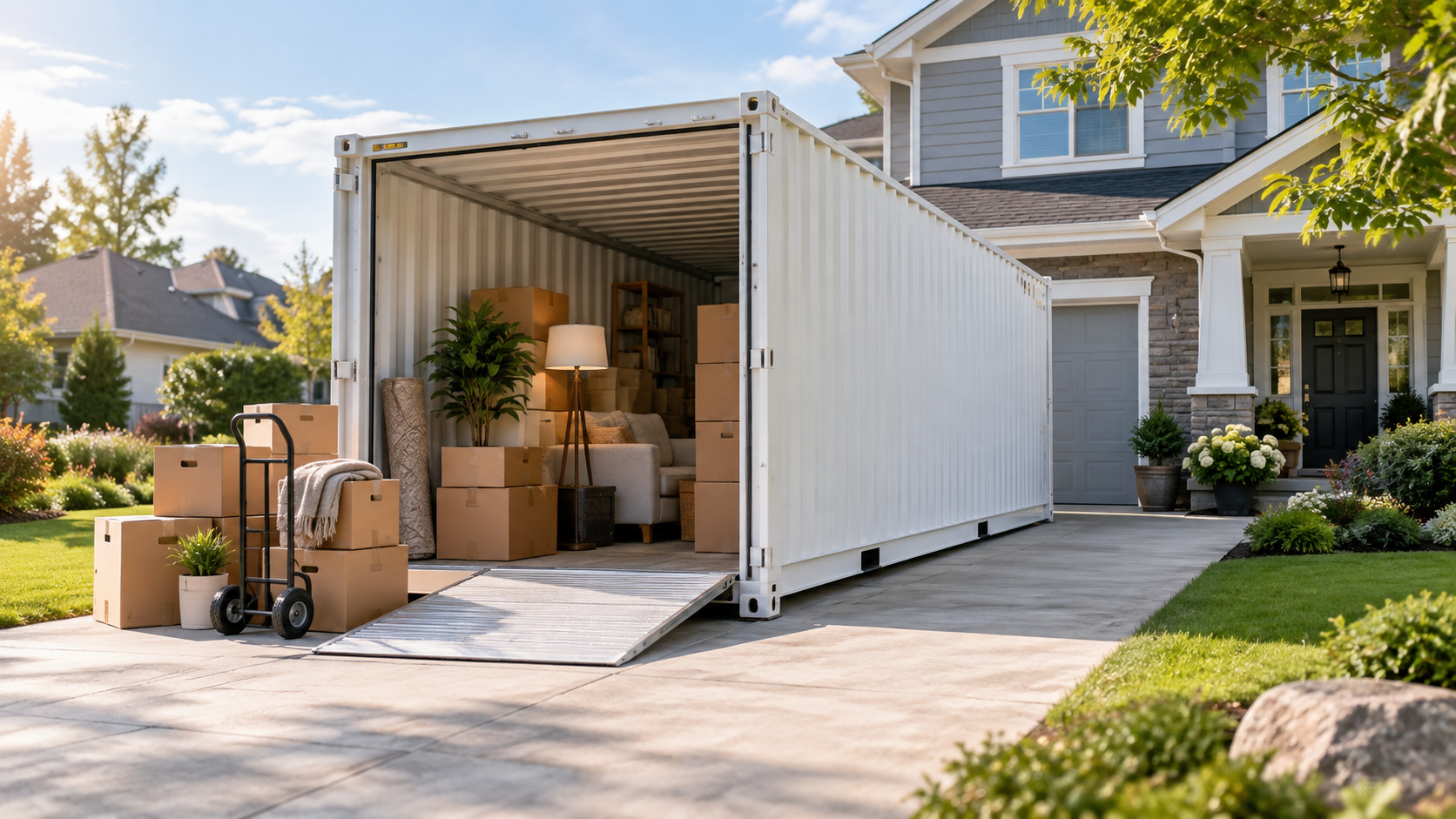
A moving container sits somewhere between hiring full-service movers and driving a rental truck yourself.
That middle ground is exactly why so many people like the idea.
The company drops a portable container at your home. You load it on your schedule. When you are ready, the company picks it up and transports it to your new address or a storage facility. No driving a 26-foot truck through rush-hour traffic. No trying to finish an entire move in one frantic afternoon.
But moving containers are not automatically the cheapest or easiest option for every move.
Price depends heavily on distance, container size, number of containers, storage time, ZIP codes, delivery access, and the company you hire. A straightforward local move can cost far less than a cross-country shipment. For long-distance domestic moves, current 2026 data puts moving-container transportation around $2,000 to $5,000 in many cases, with an average near $3,000.
That is a broad range, and honestly, it needs to be.
A one-bedroom apartment moving 300 miles and a four-bedroom house moving from Boston to Phoenix are not remotely the same project.
So the useful question is not simply, “How much does a moving container cost?”
It is: what will it cost for your move, and what are you actually getting for the money?
What Is a Moving Container?
A moving container is a portable storage unit designed to hold household belongings while they are transported or stored.
You may hear people casually call every portable moving container a “POD,” but PODS is actually a company name. Other major options include U-Pack ReloCube, U-Haul U-Box, 1-800-PACK-RAT, UNITS, and regional providers.
The basic process is similar across the category.
The provider delivers an empty container. You pack furniture, boxes, appliances, and other approved household items inside. You secure the load and lock the container. Then the company transports it.
At the destination, you normally get time to unload before the container is collected again.
If your new home is not ready yet, many services can hold the container at a storage facility in between.
That storage option is one of the biggest reasons moving containers are useful.
You are not forced to coordinate your old lease ending on Friday with your new house closing at exactly 9:00 a.m. Saturday morning. Real life rarely behaves that neatly.
How Much Does a Moving Container Cost in 2026?
For a domestic long-distance move, current national estimates put the cost to ship a moving container at roughly $2,000 to $5,000, with around $3,000 as a useful average reference point.
A smaller one-bedroom move can land near the lower end. Large homes, longer distances, multiple containers, storage, difficult delivery, or premium scheduling can push the bill much higher.
Local pricing is more variable.
Some local container moves cost only a few hundred dollars, while others reach well into four figures after delivery, pickup, monthly rental, transportation, and other charges are added.
This is why comparing only the headline container-rental price can be misleading.
The container itself is just one piece of the total.
| Cost Factor | How It Changes the Price | What to Check |
|---|---|---|
| Distance | Longer transportation usually costs more | Ask for the full origin-to-destination price |
| Container size | Larger units can cost more to rent and transport | Compare usable capacity, not only exterior length |
| Number of containers | Each extra container adds rental and transportation costs | Ask whether unused reserved containers are charged |
| Storage time | Monthly storage adds to the total | Check whether the first month is included |
| Delivery and pickup | Some quotes separate these charges | Ask whether both ends are included |
| Parking permits | Street placement may require a local permit | Check city, HOA, or apartment rules |
| Access | Difficult placement can require another delivery solution | Measure driveway and overhead clearance |
| Timing | Peak-season or expedited moves may cost more | Compare flexible and guaranteed dates |
Get a written quote that shows the major pieces clearly.
A $1,500 quote that excludes destination delivery may not actually beat a $1,800 quote that includes everything.
Moving Container Sizes Are Not Standard
This catches people by surprise.
There is no universal “medium moving container” shared by every company.
PODS currently offers 8-foot, 12-foot, and 16-foot containers. Its 16-foot unit measures roughly 16 by 8 by 8 feet and is marketed for up to about 1,200 square feet of living space, depending on how much furniture you own.
U-Pack’s ReloCube is much smaller. It measures about 6 feet 3 inches long, 7 feet wide, and 8 feet 4 inches high externally, with about 308 cubic feet of loading space. U-Pack says one Cube generally holds around one room of furnishings.
U-Haul’s U-Box is smaller again. Its current container is about 5 feet wide, 8 feet long, and 7.5 feet high externally, offering roughly 257 cubic feet and capacity for about a room and a half of household goods.
So comparing “one container” between companies does not tell you much.
You need to compare actual capacity.
| Provider / Container | Approximate Size | Approximate Capacity |
|---|---|---|
| PODS 8-ft | 8′ × 7′ × 8′ | Up to about 500 sq. ft. of living space |
| PODS 12-ft | 12′ × 8′ × 8′ | About 500-800 sq. ft.; mainly local use |
| PODS 16-ft | 16′ × 8′ × 8′ | Up to about 1,200 sq. ft. |
| U-Pack ReloCube | About 6’3″ × 7′ × 8’4″ | 308 cu. ft.; roughly one room |
| U-Haul U-Box | About 8′ × 5′ × 7.5′ | 257 cu. ft.; about 1.5 rooms |
| 1-800-PACK-RAT | 8′, 12′, and 16′ options | Varies by container and location |
These figures are planning guides, not guarantees that your exact furniture will fit.
A minimalist two-bedroom apartment and a two-bedroom home containing a sectional, king bed, dining table, garage shelves, bicycles, tools, and 70 boxes need very different amounts of space.
How Big of a Moving Container Do You Need?
Bedroom count is only a rough starting point.
Your furniture tells the real story.
Walk through the home and pay attention to bulky items first. Sofas, mattresses, dining tables, appliances, shelving, exercise equipment, outdoor furniture, bicycles, and garage contents consume space quickly.
Boxes are surprisingly easy to pack around other objects. A giant sectional is less cooperative.
Also think about how good you are at loading.
A professionally packed container can hold substantially more than one loaded casually with random empty gaps between furniture.
When in doubt, check whether the provider lets you reserve an extra container without paying the full transportation price if you do not use it. U-Pack, for example, bases ReloCube pricing on the number actually used, while U-Haul promotes a similar approach with U-Box reservations.
Moving Container vs. Rental Truck
A rental truck is often attractive because the base rental price looks low.
But you are the transportation company.
You drive it, fuel it, park it, deal with tolls, and return it according to the rental agreement.
A moving container removes the driving portion from your job.
That can be a big deal on a cross-country move.
Imagine moving from Chicago to Seattle with children, a dog, and two cars. The ability to have the household goods travel separately can simplify the trip considerably.
The tradeoff is timing. A moving container may not travel as quickly as you could drive a rental truck directly to the destination.
If you need your bed in the new house tomorrow night, check transit times carefully.
Moving Container vs. Full-Service Movers
Full-service movers do more work for you.
They can load the house, transport everything, and unload it at the destination. Some offer packing too.
That convenience costs money.
A moving container shifts the labor back to you while leaving transportation to the provider.
For people who are comfortable carrying boxes and loading furniture but do not want to drive a large truck, that can be an appealing compromise.
You can also create a hybrid move.
Hire local moving labor for three hours to load the container, let the container company transport it, and hire another crew to unload at the destination.
You still avoid paying a traditional long-distance moving crew to handle the entire project.
When a Moving Container Makes the Most Sense
Portable containers are particularly useful when the move involves uncertainty.
- Your new home will not be ready immediately.
- You want several days to load rather than a few hours.
- You are moving long distance but do not want to drive a rental truck.
- You need temporary storage between homes.
- You are renovating and need household belongings out of the way.
- You are staging a home for sale and want to remove excess furniture.
- You prefer to load your own belongings instead of having a moving crew handle everything.
- You want storage and transportation combined into one system.
The flexibility can be especially useful during real-estate moves.
If your old home closes two weeks before you get the keys to the new one, the container can often go into storage rather than being unloaded into a traditional storage unit and loaded again later.
One less round of furniture handling is rarely a bad thing.
When a Moving Container May Be a Bad Fit
Not every property can physically accommodate one.
Dense city neighborhoods can be tricky. You may have no private driveway, limited street parking, strict loading hours, or a city that requires permits for placing storage equipment on public property.
Apartment buildings can be difficult too.
Your building manager may not allow a container to remain in the parking lot for several days.
And delivery trucks need room to maneuver.
U-Pack, for example, tells ReloCube customers to plan for a standard parking space for each container plus additional maneuvering space during delivery and pickup. PODS and other providers also have placement requirements that vary with their delivery equipment.
Never assume the driver will “figure it out.”
Send photos or discuss the property with the company before delivery if access looks questionable.
Check Your City, HOA, and Apartment Rules First
This is one of the least exciting parts of a moving-container move, and one of the easiest to forget.
You may need permission to place the container.
A private driveway usually simplifies things, but HOA rules may limit how long a portable storage unit can remain outside.
Street placement can require a permit in some cities.
Apartment and condo complexes may have their own restrictions.
Ask early.
Discovering at 7:30 a.m. on delivery day that your condo association prohibits containers in the parking lot is not a fun way to begin moving week.
How the Moving Container Process Works
Once the reservation is made, the provider schedules an empty-container delivery.
You decide where it should be placed, within the company’s access rules.
Then you load.
The loading window varies by provider and service. Some companies build a few days into the move, while others rent containers by the month, giving you much more flexibility.
Once loading is complete, you lock the container and schedule pickup.
The provider transports it either directly toward the destination or to a storage facility until you request final delivery.
At the other end, you unload and the company collects the empty container.
Simple concept. Lots of small logistical details.
How to Pack a Moving Container Properly
Loading a container is not the same as putting boxes into a storage room.
The container is going to move.
That means braking, turns, vibration, highway travel, and loading onto transportation equipment.
Pack tightly enough that objects cannot wander around inside.
Heavy furniture and boxes should generally remain low. Lighter items can go higher. Mattresses and large flat pieces can sometimes help create stable vertical sections when protected properly.
Disassemble furniture when practical.
A dining table with the legs removed occupies a lot less awkward air than a fully assembled one.
Use furniture pads, stretch wrap where appropriate, moving blankets, boxes, and straps.
PODS containers, for example, include interior tie-down points in many models, but you normally provide your own straps.
Think of the Container as a Wall of Sections
One of the easiest loading approaches is to build from the back toward the door in stable sections.
Fill each section from floor toward the ceiling before moving forward.
This helps reduce large empty spaces.
Try to distribute heavy items rather than placing every book box and appliance on one side.
You also want the final section near the door to be secure. Nothing should be ready to tumble out the moment you open the container at the destination.
Future you will appreciate that.
What Should Not Go in a Moving Container?
Rules differ between companies, so always check the provider’s prohibited-items list.
But there are common categories that generally belong somewhere else.
- Gasoline, propane, and other flammable fuels
- Explosives and fireworks
- Many hazardous chemicals
- Paint or solvents when prohibited by the provider
- Perishable food
- Plants on certain interstate routes
- Important legal and financial documents
- Cash and irreplaceable jewelry
- Prescription medication you may need during transit
- Items required immediately upon arrival
Your passport should travel with you.
So should the laptop containing your work, essential medications, house-closing documents, keys, and the one stuffed animal your child absolutely cannot sleep without.
A container arriving three days later than expected should be an inconvenience, not a personal disaster.
Watch the Weight Limit
A container can look half empty and still become too heavy.
Books are the classic culprit.
So are tools, gym equipment, appliances, records, and dense furniture.
Current provider limits vary significantly. A U-Haul U-Box is rated for roughly 2,000 pounds of household goods. A U-Pack ReloCube can hold up to around 2,500 pounds. PODS limits vary by container size, with current published figures around 5,200 pounds for an 8-foot container, 4,700 pounds for the 12-foot, and 4,200 pounds for the 16-foot model.
Yes, the larger PODS containers can have lower published payload limits than the smallest one.
This is exactly why you check the specific container rather than assuming bigger always means heavier.
Do Moving Containers Protect Against Weather?
Most major portable moving containers are designed to resist normal weather exposure.
That does not mean you should treat one like a climate-controlled room inside your house.
PODS describes its units as weather-resistant rather than completely waterproof. U-Haul also markets U-Box containers as weather resistant, while U-Pack uses metal weather-resistant ReloCubes.
That distinction matters.
Pack items assuming temperature and humidity can change.
Do not leave unprotected papers, artwork, sensitive electronics, or textiles pressed directly against walls where condensation could become an issue.
Use appropriate protective materials and keep especially sensitive valuables with you when possible.
Storage Can Be the Best Part of the Deal
This is where containers have a practical advantage over rental trucks.
A truck needs to be returned.
A portable container can often become temporary storage.
If your house is under renovation, you can keep a container on the property where permitted. If you are between addresses, the provider may move it to a storage center.
Storage charges vary dramatically between companies and markets.
Do not assume the transportation quote includes indefinite storage.
Ask how monthly billing works, whether partial months are prorated, whether you can access the container while it is in storage, and how much notice the company needs to retrieve it.
Can You Access Your Stuff While the Container Is Stored?
Sometimes, but not always instantly.
If the container remains in your driveway, access is simple.
If it is in a storage facility, the company may require advance notice before pulling it out for you.
PODS, for example, currently asks customers to schedule storage-center access in advance.
If you know you may need winter coats, tax documents, baby equipment, or work supplies during storage, pack those items near the door.
Do not bury something important behind a king-size mattress, three dressers, and 58 boxes labeled “misc.”
Moving Container Insurance and Protection
Do not assume your homeowners or renters insurance automatically covers every item during a container move.
Coverage differs by policy and by stage of the move.
The container company may offer or require a protection plan for the container itself, your belongings, or both.
Read the details.
Ask about theft, water damage, transit damage, storage damage, deductibles, exclusions, and maximum coverage.
If you own expensive art, jewelry, collectibles, or specialized equipment, standard moving coverage may not be enough.
And remember that poor packing can affect damage claims.
If a lamp breaks because a 50-pound box was balanced on top of it, insurance may not turn bad packing into a covered event.
How to Compare Moving Container Quotes
Do not compare just the number printed in the largest font.
Get the full job price.
You want to know how much you will pay from the moment the empty container arrives until the empty container leaves your destination.
- Container delivery at origin
- Container rental period
- Transportation to the destination
- Storage charges, if any
- Final delivery
- Empty-container pickup
- Fuel or transportation surcharges
- Insurance or protection plans
- Cancellation or date-change fees
- Permit-related costs
- Charges for additional containers
- Expedited or guaranteed service fees
Then compare the rules.
A slightly more expensive provider may give you more loading time or a container that better fits your property.
Major Moving Container Companies to Know
PODS is probably the best-known name in the category and offers multiple container sizes with local storage and long-distance transportation options.
U-Haul U-Box uses smaller containers, which can be useful for apartments and moves where several smaller boxes are easier to place than one large unit.
U-Pack focuses heavily on long-distance moving. Its ReloCube is compact, and customers can reserve several and pay based on the number actually used.
1-800-PACK-RAT provides several container sizes in many markets and competes directly with PODS for both moving and storage.
UNITS and other regional providers can also be competitive depending on your ZIP codes.
Availability matters more than rankings.
The company with the perfect container on a comparison website is not useful if it does not serve your destination.
How Early Should You Book?
Do not wait until the week before a summer move if you have another option.
Late spring and summer are traditionally busy moving periods in the United States. End-of-month dates can be busy too because many leases begin and end around that time.
Booking earlier gives you more choice in delivery dates and equipment availability.
If you do not know your exact destination address yet, ask whether the provider can reserve the move using the destination city or ZIP code and update details later.
Also ask how cancellation works.
Moving dates have a habit of changing the moment attorneys, landlords, contractors, and closing schedules become involved.
Moving Containers for Renovation Projects
You do not need to be moving houses to rent one.
A portable container can be extremely useful during a kitchen renovation, floor replacement, major painting project, water-damage repair, or whole-house remodel.
Instead of stacking every chair, table, and box in the garage, you move them into temporary storage right outside.
Contractors get a clearer workspace, and the rest of the house stays more livable.
Just remember to check local rules if the container will remain outside for weeks or months.
Moving Containers for Home Staging
This is another underrated use.
If you are preparing to sell, you often need to remove belongings before you actually have a new home.
A container solves that nicely.
Pack off-season clothing, excess furniture, collections, garage clutter, extra toys, and half of what is inside overstuffed closets.
The house becomes easier to stage and photograph.
When it sells, the same container can become part of the actual move.
No unloading into a storage unit and then loading everything again later.
Common Moving Container Mistakes
The biggest one is underestimating space.
People count rooms rather than belongings.
Then moving day arrives and the garage alone seems to contain another apartment’s worth of stuff.
Another mistake is failing to measure large furniture against the container door opening and interior dimensions.
A sofa technically shorter than the container may still be difficult to maneuver through the doorway.
Then there is poor weight distribution.
Do not build one wall of books, tools, and appliances while the opposite side contains pillows.
And secure the load.
A container is not going to remain perfectly still during transport.
Can a Moving Container Save Money?
It can, especially compared with full-service long-distance movers.
But the answer depends on how much labor you are willing to provide yourself.
If you hire separate crews to pack every box, load the container, unload it, assemble furniture, and unpack everything, the total can start looking much closer to a traditional moving service.
That does not mean the container is a bad choice. You may still prefer the storage flexibility.
Just compare complete move costs rather than assuming DIY loading automatically means “cheap.”
FAQ
How much does a moving container cost in 2026?
For domestic long-distance moves, current U.S. estimates commonly fall around $2,000 to $5,000, with roughly $3,000 as an average reference point. Local moves can cost much less. Distance, container size, storage, number of containers, and ZIP codes have a major effect on pricing.
What size moving container do I need?
It depends on your belongings rather than bedroom count alone. Small containers work well for studios, individual rooms, or partial moves. Larger 16-foot containers can handle much of a typical two- or three-bedroom home’s contents, while large households may need multiple units.
Is a moving container cheaper than hiring movers?
Often, especially for long-distance moves when you load and unload yourself. But compare the complete cost, including transportation, storage, delivery fees, permits, insurance, and any hired loading help.
Can I keep a moving container in my driveway?
Usually, if the provider can safely place it and local rules allow it. HOA regulations, rental agreements, city codes, and driveway conditions may limit placement or how long the container can remain there.
Do I need a permit for a moving container?
You may need one if the container will sit on a public street or other regulated property. Rules differ by city and neighborhood, so check local requirements before delivery rather than relying on a national rule.
Can a moving container stay in storage between homes?
Yes. Storage is one of the main advantages of portable moving containers. Many companies can hold the loaded container at a storage facility until your new home is ready, although monthly storage fees and access rules vary.
Are moving containers waterproof?
Major providers generally describe their units as weather-resistant rather than promising that every container is completely waterproof. Pack belongings securely, protect moisture-sensitive items, and keep irreplaceable valuables with you.
Conclusion
A moving container makes sense because it separates two jobs that traditional moving often forces you to do at the same time.
You load.
Someone else handles the highway.
That can make a move feel considerably less chaotic.
You can spend several days packing the container instead of racing against a rental-truck clock. If the new house is not ready, the container can often go into storage. If you are renovating, it can sit nearby and keep furniture out of the work zone.
But convenience does not mean you should book the first container you see.
Compare actual sizes. One company’s “container” may hold dramatically more than another’s.
Check the weight limit.
Measure your largest furniture.
Confirm the company serves both ZIP codes. Ask about storage, delivery fees, final pickup, insurance, cancellation terms, and how long you are allowed to load.
Then check the property.
Is there enough driveway space? Can the delivery equipment maneuver? Are overhead branches or wires in the way? Does the HOA allow portable storage? Will your city require a street permit?
Those little questions are much easier to solve three weeks before moving day than while a delivery driver waits at the curb.
For long-distance moves, current 2026 pricing suggests roughly $2,000 to $5,000 as a useful broad range for domestic container transportation, with an average near $3,000. But real quotes can sit well outside that range because moving routes and household sizes vary so much.
So get several quotes based on the same information.
Same origin. Same destination. Same approximate amount of belongings. Same storage needs.
Then compare the total, not just the first price you see.
If you find the right fit, a moving container can take one of the worst parts of moving – the rushed coordination between packing, transportation, storage, and closing dates – and make it much more manageable.
You still have to pack the kitchen.
No company has invented a container that does that part for you yet.
But at least you do not have to drive it across the country afterward.
Leave a Reply