
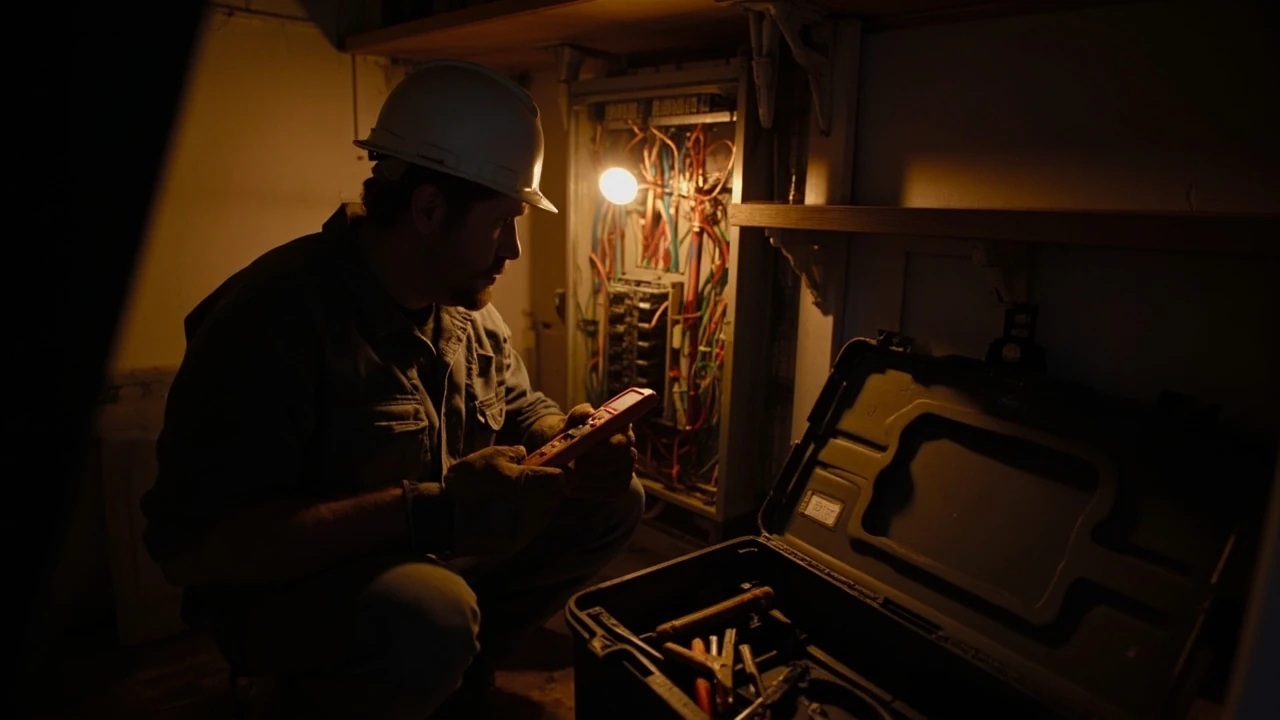
Emergency electrical repair: how to recognize it, respond to it, and avoid costly mistakes
A burning smell from a kitchen outlet, a breaker that will not reset, half the house going dark on a Sunday night — these are the situations that push homeowners to search for emergency electrical repair, and the clock starts the moment something goes wrong. The goal of this guide is to help you decide quickly whether the problem actually qualifies as an emergency, what you can safely do before a technician arrives, and how to find qualified help without paying for services you do not need or, worse, making a dangerous situation worse.
Electrical incidents are a leading cause of residential structure fires, and the difference between a close call and a tragedy is often a calm, informed first response. The advice below focuses on what a careful homeowner or renter can do, what a licensed electrician should handle, and which red flags mean you should be calling your utility or 911 instead of an electrician.
What counts as an electrical emergency
The phrase “electrical emergency” gets used loosely, but licensed electricians, fire departments, and utility companies generally agree on a short list of conditions that justify an urgent response. If any of the following are happening right now in your home, treat the situation as an active emergency and act on the steps in the next section before you call anyone.
- Active smoke, sparks, or fire coming from an outlet, switch, panel, or appliance.
- A persistent burning or “hot plastic” smell with no obvious source.
- Loss of power that affects critical loads such as medical equipment, a sump pump during rain, a well pump, or a furnace in cold weather.
- Repeated tripping of a breaker that will not stay reset, or breakers that trip immediately when reset.
- Visible damage to wiring, such as melted insulation, exposed copper, scorch marks on outlets, or water intrusion into the panel.
- A tingling sensation when you touch an appliance, a metal faucet, or a light switch.
- Flooding that has reached electrical outlets, appliances, or the service panel.
A single dead outlet, a flickering lamp, or a tripped GFCI in a bathroom is usually a maintenance issue, not an emergency. The right call there is to schedule a normal service visit during business hours, not to wake up an on-call electrician at 2 a.m.
First steps to take before you call
How you respond in the first few minutes often determines whether the damage is limited to a single device or spreads to the panel and the rest of the home. The actions below are safe for a layperson and are the same steps a dispatcher will often walk you through while an electrician is on the way.
- If there is active fire, leave the home and call 911. Do not try to fight an electrical fire with water.
- If you see smoke or smell burning but no flames, shut off the affected breaker if you can do so safely. If the panel is hot, smoking, or wet, stay away from it and call the fire department.
- Unplug any device that was in use when the problem started. A failing appliance can keep tripping the circuit even after other loads are removed.
- If water is involved, do not touch the panel, breakers, outlets, or any plugged-in devices until the area is dry and the power is off at the main if it is safe to reach it.
- Document what you saw and when: sparks, the order in which rooms lost power, the exact smell, any sounds. This information saves the electrician diagnostic time and may matter for an insurance claim.
- Move people and pets out of the affected area, especially children, who tend to investigate scorched outlets.
These steps are general guidance, not a substitute for professional advice. If anything about the situation feels unstable, your local utility’s emergency line and 911 are the correct first calls; a qualified electrician can be reached once the scene is safe.
What a qualified emergency electrician actually does
When you call for urgent service, the technician’s job is not just to “get the lights back on.” A licensed electrician responding to an emergency electrical repair call typically follows a structured process that starts with safety and ends with a long-term fix, not a band-aid.
- Initial safety assessment: verifying that the panel is safe to open, checking for hot spots with a thermal camera or infrared thermometer, and confirming there is no active arcing.
- Isolation: identifying which circuits and devices are involved and de-energizing only what is necessary to work safely.
- Root cause diagnosis: tracing the failure back to its source, which may be a single failed device, a damaged cable, a failing breaker, or a panel-level problem.
- Immediate repair: replacing the failed component, repairing damaged wiring, or installing a temporary solution that brings the system back to a safe, code-compliant state.
- Verification: testing the affected circuits under load, confirming proper grounding and bonding, and verifying that GFCI and AFCI protection is functioning where required.
- Recommendations: documenting any follow-up work, code deficiencies, or aging components that should be addressed during a planned visit.
That last step matters. A good emergency technician leaves you with a clear list of what was fixed tonight and what needs to be scheduled later, so the same problem does not return next month at a worse moment.
Common problems that trigger emergency calls
Although every home is different, the same handful of issues show up again and again in service logs. Understanding which problems are most common can help you prioritize prevention and recognize trouble early.
Overloaded circuits and repeated breaker trips
Older homes were not wired for today’s appliance loads. A kitchen with a microwave, espresso machine, toaster, and air fryer on one circuit is a classic setup for nuisance tripping — and occasionally for a breaker that will not reset at all because the underlying wiring has been stressed for too long. Repeated trips are the breaker’s way of saying “stop.” Ignoring that signal is how overheated connections start.
Failed breakers and aging panels
Breakers are mechanical devices that wear out. A breaker that trips once and then never resets, that feels loose in the panel, or that shows discoloration around its face is signaling failure. Panels themselves have a service life; some brands installed in past decades are now the subject of safety advisories because of documented fire risk. An emergency visit often turns into a panel evaluation and a planned replacement quote.
Damaged wiring from rodents, renovations, or age
Wire insulation can be gnawed by mice or squirrels in the attic or walls, nicked by a drill bit during a recent DIY project, or simply embrittled by decades of heat cycling. Damaged insulation can cause arcing inside a wall with no visible sign until something fails or catches fire.
Storm, water, and surge damage
Lightning strikes, fallen tree limbs, and water intrusion from flooding or roof leaks are all common triggers. Surges can take out electronics and damage panel components instantly, while moisture can create ground faults and arcing that show up hours or days after the original event.
Failed devices and appliances
Sometimes the emergency is not the house wiring at all — it is a failing appliance whose internal short is pulling the circuit down. Identifying the device quickly is the difference between a one-hour service call and a much longer diagnostic.
When to call the utility, the fire department, or 911 instead
Not every urgent electrical situation should route to a private electrician first. Knowing who to call in the first minute can prevent injury and reduce damage.
| Situation | First call | Why |
|---|---|---|
| Active fire, smoke you cannot locate, or flames from an outlet or panel | 911 | Fire response takes priority over electrical repair and may require utility shutoff coordination. |
| Downed power line on or near the property | Utility emergency line and 911 | Lines can be energized at distance and require utility crews, not a private contractor. |
| Whole-home outage with no obvious inside cause | Utility first | The problem may be on the grid side, and a private electrician cannot help until service is restored. |
| Flooding reaching outlets, panel, or appliances | Utility and 911 if needed | Water and energized wiring is a lethal combination; power must be cut at the meter or transformer. |
| Single failed device, one dead outlet, breaker that resets cleanly | Scheduled electrician during business hours | This is rarely a true emergency, and an after-hours visit will carry a premium. |
When in doubt, call your utility’s published emergency number. Dispatchers there are trained to triage and will tell you whether to evacuate, wait, or arrange a private service call.
How to find a legitimate emergency electrician
The urgency of an electrical problem is exactly what makes homeowners vulnerable to scams, overcharges, and unlicensed work. A few practical checks can dramatically reduce the risk of a bad outcome.
Verify licensing and insurance before work begins
Electrical licensing is regulated at the state or local level in the United States. A legitimate contractor will provide a license number without being asked, and that number should be verifiable on your state or municipality’s licensing board website. Insurance — general liability and workers’ compensation — protects you if a worker is injured on your property. Ask for a certificate of insurance; “we’re covered” is not the same as proof.
Ask about the on-call structure
Some companies run their own 24/7 dispatch; others use an answering service that forwards calls to whoever is available. There is nothing wrong with the second model, but it is reasonable to ask who is actually coming, whether they are an employee or a subcontractor, and whether that technician is licensed under the same license number the company quoted you.
Get the diagnostic fee in writing
Most legitimate emergency services charge a trip charge or diagnostic fee that is higher than a scheduled visit. That fee should be disclosed when you book, not when the truck is in your driveway. Companies that cannot or will not quote the diagnostic fee before dispatch are a yellow flag.
Watch for pressure tactics
“Sign now, the price goes up in ten minutes” or “I have other calls, I can only do this if you commit tonight” are classic pressure patterns. A real emergency does not require you to commit to a multi-thousand-dollar scope of work on the spot. If a major replacement is recommended, ask for it in writing with a clear description of the problem, the proposed fix, and the parts involved. You are entitled to a second opinion on big-ticket work, even on a Saturday night.
What emergency work usually costs
Pricing varies widely by region, time of day, and the scope of the failure, but a few general patterns are consistent across most U.S. markets. The table below reflects typical structures rather than guaranteed prices; the actual quote from your contractor may differ.
| Service element | Typical structure | What drives the cost |
|---|---|---|
| After-hours trip / diagnostic fee | Higher than a scheduled visit, often a flat amount | Time of day, day of week, distance, regional market |
| Hourly labor rate, emergency | Premium over business-hour rate | On-call pay, overtime rules, local labor market |
| Common parts (breakers, GFCI outlets, device) | Material cost plus markup | Part availability, panel brand, code requirements |
| Quoted as a project, not an hourly repair | Scope, permits, utility coordination, code upgrades triggered by the work |
Be cautious of any quote that bundles a vague “safety upgrade” into an emergency visit. A legitimate technician will separate the work that resolves tonight’s failure from the recommended follow-up that can be scheduled at a normal rate.
How to reduce the odds of a middle-of-the-night call
You cannot prevent every failure, but most emergency calls have warning signs that show up weeks or months earlier. A short list of habits dramatically reduces the chance of a genuine emergency electrical repair situation.
- Know which breakers control which loads, and label the panel clearly. A labeled panel turns a crisis into a five-minute decision.
- Replace breakers that trip repeatedly. A breaker that has tripped hard multiple times is more likely to fail than a new one.
- Address warm or discolored outlets, switches, or cover plates immediately. Heat at a device is a sign of a loose connection that is about to fail.
- Have a licensed electrician inspect the home every few years, especially if the home is more than 25 years old, has been renovated, or has a panel from a brand with known issues.
- Install combination AFCI protection where required by current code, particularly in bedrooms and living areas.
- Use surge protection at the panel and point-of-use for sensitive electronics.
- Keep the area around the panel clear so it can be reached and worked on quickly.
If you want a single, practical habit to build, it is this: when something electrical behaves unusually, write down what you saw, when it happened, and which circuit was involved. Patterns are the only way a technician — or you — can spot a problem before it becomes a midnight page.
What to do while you wait for the technician
If the immediate danger has been addressed and you are waiting for an on-call electrician, a few small steps make the visit faster and less expensive.
- Clear a path to the affected area and the panel. Furniture moves, a wet floor, or a blocked panel turns a 20-minute repair into a 60-minute one.
- Gather any documentation you have: recent inspection reports, the panel brand and approximate age, and a list of any work done since you owned the home.
- Identify which loads are critical. If the technician needs to prioritize, knowing which circuits feed medical equipment, a sump pump, or a heating system helps them sequence the work.
- Keep the area off-limits to children and pets. Tape or a chair across the doorway is a reasonable temporary barrier.
- Have your phone available. A technician may call ahead with questions, additional instructions, or a more accurate arrival time.
For a broader look at how licensed electricians and home-service companies structure their urgent response work, this overview of emergency electrical services walks through the typical scope of an after-hours visit, from initial assessment to follow-up recommendations.
Documentation and insurance considerations
Electrical failures sometimes lead to insurance claims, particularly when there is fire, water, or surge damage. The way you document the incident can meaningfully affect how the claim is handled.
- Take dated photos and short videos of any visible damage before it is cleaned up or repaired. Include wide shots and close-ups.
- Save the technician’s written report, the parts list, and the invoice. Insurers routinely ask for these.
- Do not throw away failed devices or wiring until the adjuster has seen them or the claim is closed.
- If you suspect a product defect — a breaker, a panel, an outlet, or an appliance — keep the failed component and any model or serial numbers.
- Report the loss to your insurer promptly; most policies have a notification window measured in days, not weeks.
For background on how residential electrical systems are designed and protected, the electrical wiring entry on Wikipedia covers the principles of branch circuits, grounding, and overcurrent protection that underpin most of the issues discussed here.
Special situations: rentals, older homes, and homes with known panel issues
Some properties carry higher baseline risk and deserve a more proactive approach.
Rentals
In a rental, the landlord or property manager is usually responsible for the electrical system. Tenants should document problems in writing, avoid DIY fixes, and report urgent situations immediately so the owner can authorize emergency work. Most jurisdictions require landlords to respond to true electrical emergencies within hours, not days.
Older homes
Homes built before the 1960s may have knob-and-tube wiring, cloth-insulated wires, or panels with limited capacity. These systems can be safe when undisturbed but become hazardous during renovations or when loaded with modern appliances. An emergency visit in an older home often reveals a list of latent issues that should be addressed in a planned upgrade, not in a panic.
Known panel issues
Several panel brands installed between the 1950s and the 1990s have well-documented safety concerns. If you know your home has one of these panels, the prudent step is a planned replacement rather than waiting for a failure. A genuine emergency is the worst time to discover that the panel you have cannot accept modern breakers, or that replacement parts are unavailable.
Common myths that lead to bad decisions
A few persistent myths show up in online forums and well-meaning neighbor advice. Clearing them up helps homeowners make better calls when it matters.
- “If the breaker reset, the problem is fixed.” A breaker that trips and resets may simply be doing its job. The underlying cause — a failing device, an overloaded circuit, a loose connection — is still there and may recur.
- “It’s just a flicker, it’s fine.” Recurring flickers or dimming when large appliances start can indicate a loose neutral, an overloaded service, or a failing utility connection. None of those are fine.
- “You can save money by letting an unlicensed handyman do the diagnostic and then calling an electrician for the repair.” In most jurisdictions it is illegal for an unlicensed person to perform electrical work for hire, and the diagnostic itself is part of the regulated work. It can also void insurance coverage and create liability if something goes wrong later.
- “Turning it off and on again is a real fix.” Resetting a breaker that immediately re-trips is not a fix. Forcing it on with the load removed is a diagnostic step, not a repair, and the original load should not be reconnected until the cause is known.
Frequently asked questions
What is the difference between emergency electrical repair and a normal service call?
An emergency call is for situations that pose an immediate safety risk, an active hazard, or a loss of power to critical loads. A normal service call covers non-urgent work such as adding an outlet, replacing a fixture, or troubleshooting a single dead device. Emergency calls typically carry a higher trip charge and an after-hours labor rate.
How fast can an emergency electrician actually arrive?
Response times vary by region, time of day, and the company’s on-call coverage. In dense urban areas, arrival within an hour is common. In rural areas, two to four hours is more typical. When you call, ask for a realistic window rather than a vague “we’ll be there soon.”
Is it safe to keep using the home if only part of the circuits are out?
It depends on why the circuits are out. If a single breaker tripped and the rest of the home is normal, it is usually safe to stay while you arrange a service visit. If the partial outage is accompanied by burning smells, warm devices, or signs of water intrusion, the safer choice is to leave the affected area and call for help.
Can I do any of the repair work myself to save money?
Homeowners can legally do limited electrical work on their own homes in many jurisdictions, but the work must still meet code, be inspected where required, and be done with the power off and verified off. During an active emergency, the safer and usually faster path is to leave repair work to a licensed technician, especially when the panel, service entrance, or any wet condition is involved.
Will my homeowner’s insurance cover emergency electrical repair?
It depends on the policy and the cause. Damage from a sudden, accidental event such as a power surge or a covered peril is often covered; gradual wear or pre-existing code violations usually is not. Your insurer can clarify what your specific policy includes, and the documentation gathered during the emergency visit will matter when the claim is filed.
How do I know if my panel is one of the problematic brands?
The panel brand and model are usually printed on the panel door label or on the breaker face. If you cannot identify it from a photo, a licensed electrician can identify it during a routine inspection. Some brands have well-documented safety advisories; if yours is on that list, a planned replacement is far less expensive and disruptive than a failure-driven emergency.
What information should I have ready when I call?
Have your address, the closest cross street, the symptoms you observed, when they started, what you have already done, and whether anyone is in immediate danger. If you know the panel brand and approximate age, mention that too. The dispatcher will use this to send the right technician with the right parts.
Can an emergency electrician work in the rain or at night?
Many repairs can be performed safely in low light or in covered outdoor areas, but outdoor service work during active rain or lightning is generally paused. Technicians will stabilize the situation — for example, isolating a wet circuit — and return when conditions are safe to complete permanent repairs.
Should I turn off the main breaker while waiting for help?
Only if a dispatcher or the technician on the phone specifically tells you to, and only if you can reach the main safely. A whole-home shutdown disables sump pumps, medical equipment, and security systems, so it is not a default step. The panel and main breaker themselves can be dangerous; do not touch them if they are hot, smoking, or wet.
How do I avoid being overcharged for an emergency visit?
Get the diagnostic fee and any minimum labor amount in writing before the technician is dispatched. Ask for line-item pricing on parts. Decline any scope you are not comfortable approving on the spot and ask for it in writing to review. A legitimate company will not pressure you to sign a large project during an emergency call.
Related reading from Home Revive Group
If you found this guide useful, these related posts from the Home Revive Group archive cover other home systems that benefit from the same kind of early attention:
Leave a Reply