
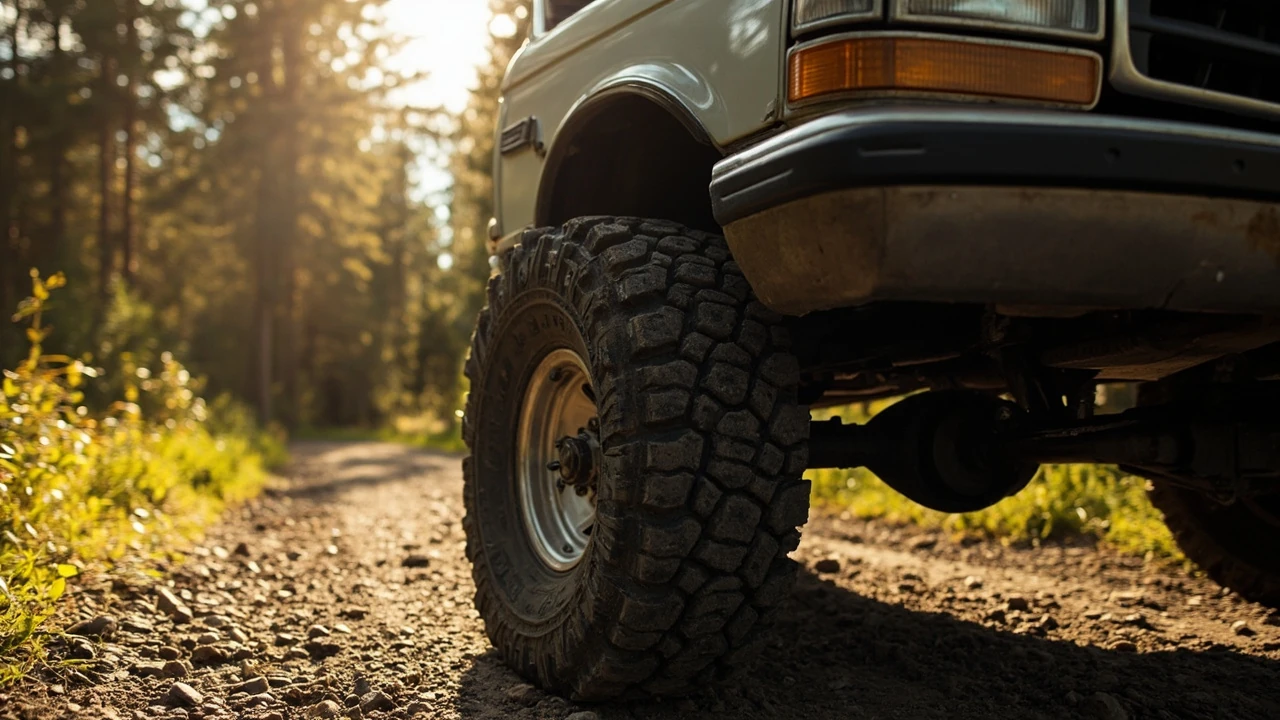
Firestone Destination MT2: what the tire is and who it actually fits
The Firestone Destination M/T2 is a mud-terrain light-truck tire that has earned a steady following among Jeep, Bronco, and pickup owners who want real off-road bite without giving up too much daily comfort. After its first public testing rounds on muddy Virginia trails, the design has settled into the market as a credible second-generation update to the original Destination M/T that showed up two decades ago. The short version: it is a serious off-road tire that still behaves on the way to the trailhead, and the rest of this page explains the trade-offs in detail.
Because the question most buyers actually have is “is this the right tire for my truck and my driving,” the guide below walks through the design, the published sizes, the on-road manners, the off-road behavior, the maintenance it asks for, and the buyers it suits. The same tire is not the right answer for a suburban commuter, a road-trip family hauler, and a weekend rock-crawler, so the goal here is to help you match the tread to the way you actually drive.
Where the Destination M/T2 sits in the mud-terrain market
Mud-terrain tires are usually defined by three things: deep, widely spaced tread blocks, reinforced sidewalls, and an open shoulder that helps the tire bite into soft ground and self-clean as it spins. The Destination M/T2 is built around all three, and its position in the market is closer to a “daily-drivable mud-terrain” than a dedicated competition tire. That positioning matters because it sets expectations for noise, wear, and grip on wet pavement.
For a buyer comparing options, the practical question is how the M/T2 lines up against the well-known all-terrain tires in the same brand family and against the most common mud-terrain competitors. The table below is a starting frame, not a lab measurement, because real-world feel depends on the vehicle, the wheel diameter, and the air pressure you run.
| Tire category | Typical on-road noise | Off-road bite in mud | Expected tread life | Best fit |
|---|---|---|---|---|
| Highway / all-season (passenger) | Low | Poor | Long | Pavement-only daily drivers |
| All-terrain (e.g., Destination A/T2) | Low to moderate | Good on dirt, light mud | Long | Suburban trucks used occasionally off-road |
| Mud-terrain (e.g., Destination M/T2) | Moderate, with hum at speed | Strong in deep mud and loose rock | Shorter than A/T | Off-road enthusiasts who still drive daily |
| Specialty off-road (comp mud, rock crawler) | Loud | Specialized | Variable | Dedicated trail rigs |
The headline takeaway: mud-terrain tires like the Destination M/T2 are a deliberate compromise. You give up some on-road refinement and some tread life to get better grip, self-cleaning, and puncture resistance in the conditions they are designed for.
Design features worth knowing before you buy
Before the fitment and pricing conversations, it helps to know what is actually on the tire. A mud-terrain product is more than a tread pattern, and the small parts of the design are often what make the difference between a tire that lasts one season and one that lasts several.
- Aggressive tread blocks with wide voids. The blocks are shaped to bite into soft ground and to flex under load, while the voids give mud somewhere to go as the tire rotates.
- Open shoulder and sidewall lugs. These extend the gripping surface to the side of the tire, which helps in ruts, on rocks, and when you need to claw up a loose hillside.
- Reinforced sidewall construction. A tougher sidewall resists punctures from brush and rocks, and it also lets drivers drop air pressure for traction without worrying as much about damaging the tire.
- Stone and mud ejectors. The tread geometry is shaped to throw debris out as the tire spins, which keeps the voids from getting packed full and turning the tire into a slick.
- LT (light-truck) focused construction. Most published sizes are LT load ranges, which is what the tire is engineered around and where the sidewall strength really shows up.
None of those features matter if the tire is the wrong size for the wheel or the wrong load range for the vehicle, so the next sections cover sizing and what to check before mounting.
Common sizes and what they tell you
For light-truck mud-terrain tires, the size chart is more than a list of numbers. Each size tells you the load capacity, the recommended wheel width, and whether the tire is designed around a passenger ride or a working payload. A buyer who picks the right size for the vehicle and the wheel usually has a much better first impression than a buyer who only matches the overall diameter.
| Example size | Common use | Typical load range | Approx. rim width | Notes |
|---|---|---|---|---|
| LT265/75R16 | Mid-size SUVs, half-ton trucks | E | 7.0 – 8.0 in | A common “step up” from a P-metric tire |
| LT285/75R16 | Jeep Wrangler, older Bronco, pickups | E | 7.5 – 8.5 in | Popular for stock-height 4x4s |
| LT315/75R16 | Lifted trucks, dedicated off-road use | E | 8.0 – 10.0 in | Heavier, more aggressive look |
| LT35x12.50R17 | Lifted half-tons and three-quarter-tons | E | 8.5 – 10.0 in | Often used with aftermarket wheels |
| LT37x12.50R17 | Built rigs, dedicated trail use | D or E | 8.5 – 10.0 in | Confirms need for clearance and gear ratio check |
Three things to do before ordering any of these sizes: confirm the wheel width is within the tire maker’s recommendation, check the vehicle’s payload requirement against the tire’s load index, and make sure there is enough fender clearance for the new overall diameter, especially on a truck that already has a leveling kit or mild lift.
On-road behavior: what changes after the swap
Any mud-terrain tire changes the way a vehicle feels on the street, and it is fairer to describe the changes than to call them good or bad. Drivers moving from an all-terrain or a highway tire to the Destination M/T2 should expect the following, based on the design and the kind of feedback that shows up in long-term test reports.
- Audible hum at highway speed. The wide voids between tread blocks create a noticeable drone, especially between 45 and 65 mph. It is not a whistle, and it is not the same kind of noise as a worn suspension bushing, so most drivers adapt to it within a few hundred miles.
- Slightly slower steering response. The taller, more flexible sidewall flexes a bit more on turn-in, so a heavy truck will feel marginally less precise at parking-lot speeds. This is not a safety issue; it is a feel issue.
- Lower fuel economy. The added rotating mass, the aggressive tread, and the higher recommended pressures for heavier loads all work against mileage. A realistic expectation is a single-digit percentage drop compared with a low-profile all-season tire.
- Better wet grip than expected. Mud-terrain tires are not designed for rain, but a well-engineered one like the M/T2 still evacuates water through the voids and the circumferential channels, which keeps hydroplaning risk reasonable as long as the tread is fresh.
- More road feel through the wheel. Larger blocks transmit more texture from the road surface, which is one reason off-road enthusiasts prefer the design but one reason commuters often do not.
Real-world on-road feedback from a long-term test on a lifted early-nineties Ford Bronco summarized the tire this way: noticeably quieter on the open road than the original M/T design it replaced, with the expected tread whine at speed and a confident feel on wet pavement and gravel. That description, drawn from a real review of a mounted set, is a useful baseline for anyone trying to imagine daily life with the tire.
Off-road behavior: where the tire earns its place
The design pays off where it was designed to work. In mud, on rocks, and in loose soil, the Destination M/T2 leans into its strengths.
- Mud. Wide voids and shoulder scoops let the tire clear itself as it spins, so it keeps biting into soft ground instead of packing up. Dropping tire pressure by a few psi at the trailhead usually improves traction further without pushing the sidewall past its safe flex range.
- Rock. The reinforced sidewall and the side lugs protect the tire from sharp edges and give the driver a wider contact patch to choose from when picking a line.
- Sand. Like most mud-terrain tires, the M/T2 works in sand when pressure is lowered and momentum is kept up, but it is heavier than a sand-specific tire, so a driver in deep dunes will feel the extra rotating mass.
- Snow. Mud-terrain tires are not a substitute for a proper winter tire, and the same wide voids that help in mud can pack with snow. Owners in snowy regions either run a dedicated winter set or accept reduced winter traction in exchange for off-road ability the rest of the year.
A practical habit that helps in all four environments is to carry a quality tire-pressure gauge and a portable compressor. Running lower pressure on the trail and re-inflating before returning to the pavement extends tire life and improves safety on the highway.
Maintenance and ownership expectations
Mud-terrain tires live harder than highway tires, and the difference shows up in how owners should treat them. None of the items below are difficult, but skipping them shortens the life of even a well-built tire.
- Rotate every 5,000 to 6,000 miles. Aggressive treads wear unevenly, especially on a daily-driven truck, and rotation is the cheapest way to balance that wear.
- Check alignment after any hard impact. A deep pothole or a rock strike can change alignment angles, and a mud-terrain tire with even a small alignment issue will wear the shoulder blocks quickly.
- Re-torque lug nuts at the recommended interval. This is a habit for any new set of wheels and tires but is especially worth following for a heavier LT tire.
- Clean the wheels and the tire sidewalls after muddy trips. Mud holds moisture against the wheel and the rim, which can shorten the life of both, and caked-on debris hides small cuts you would otherwise catch early.
- Watch for stone drilling in the tread. The voids are designed to throw debris out, but small stones can lodge in the base of the blocks. Pulling them out before a long highway drive prevents them from being driven deeper into the tire.
Set a reminder on the phone or in the owner’s log for rotation intervals, because the mud-terrain pattern hides uneven wear better than a smooth highway tire does. The wear will still be there; it just does not show up as obviously until the tire is past the safe-tread threshold.
Price, value, and how to think about the comparison
Comparing mud-terrain tires on price alone is one of the easiest ways to make a bad decision. A cheaper tire that wears out in two seasons is more expensive than a slightly pricier tire that lasts four, and a tire that loses a sidewall on the trail costs more than any price difference. The honest way to compare value is to combine purchase price, expected mileage, and the chance of damage from the terrain the buyer actually drives in.
| Decision factor | What to weigh | Why it matters |
|---|---|---|
| Purchase price per tire | Installed cost, including mounting and balancing | The starting line for any comparison |
| Expected mileage | Manufacturer estimate and real-world owner reports | Sets the real cost per mile |
| Off-road use | Frequency, terrain type, and how often the tire is aired down | Drives durability and damage risk |
| On-road time | Daily miles and highway speed | Drives noise and fuel-economy trade-off |
| Load needs | Tow, haul, or carry passengers | Determines correct load range and pressure |
| Climate | Snow, ice, or hot pavement most of the year | Determines whether a mud-terrain is even the right category |
A driver who spends 90 percent of miles on pavement will usually find a better value in a quality all-terrain tire, even if the per-tire price is similar. A driver who spends most weekends in mud, on rocks, or on forest-service roads will usually get more value from a mud-terrain like the Destination M/T2, because the design matches the actual use.
Who the Firestone Destination M/T2 is right for
After walking through the design, the on-road feel, the off-road behavior, and the maintenance, the fit question is easier to answer. The tire is a strong match for a specific kind of owner, and it is a poor match for a different kind of owner, and being honest about which group you are in saves a lot of money.
- Daily-driven 4×4 owner who wheels most weekends. This is the core audience. The tire is quiet enough to commute on, strong enough for trail damage, and priced in a range that does not punish a buyer who replaces tires every few years.
- Work truck that sees occasional off-road duty. The LT construction handles a payload, the tread is forgiving in mud and gravel, and the tire is widely available in common half-ton sizes.
- Overland or backcountry traveler on forest-service roads. The reinforced sidewall and the stone-ejecting tread match the long, rough, slow-speed miles this kind of driving produces.
- Owner who is willing to maintain tires. Rotation, pressure checks, and post-trail cleaning are part of the deal, and the tire rewards an owner who treats it as a maintenance item, not a forgotten part.
The tire is a poor match for a suburban commuter, a highway-only road-trip family vehicle, or a daily driver in a region with long, icy winters. In those cases, a highway or all-terrain tire will be quieter, longer-lasting, and safer in the conditions the driver actually faces.
How the Destination M/T2 compares to its stablemates
Firestone’s light-truck lineup includes several off-road-capable products, and buyers often end up choosing between a couple of them rather than between a Firestone and a competitor. The table below lines up the most common choice points.
| Model | Category | Strength | Trade-off |
|---|---|---|---|
| Destination LE3 | Highway all-season | Quiet ride, long tread life | Limited off-road ability |
| Destination A/T2 | All-terrain | Balanced on- and off-road | Less bite in deep mud than an M/T |
| Destination M/T2 | Mud-terrain | Real mud and rock performance | More noise, shorter life than A/T |
| Destination X/T | All-terrain (crossover) | Crossover-friendly sizing and feel | Less aggressive than an M/T |
For a buyer already inside the Firestone ecosystem, the rule of thumb is simple. If you go off-road more than a few times a year and you do not mind the noise, the M/T2 is the right pick. If you go off-road once or twice a year and you drive a lot of highway miles, the A/T2 is the better balance.
Buying checklist before you order
Most tire-buying regrets come from skipping one of the small checks below. None of them take long, and they turn an order into the right order.
- Confirm the size and load range against the vehicle’s door-jamb placard, not just the existing tire.
- Confirm wheel width and backspacing against the tire maker’s published range.
- Decide whether the truck needs a re-gear for larger diameters, and price that into the total cost.
- Plan for the four-tire plus spare cost; mixing tire designs on the same axle hurts handling.
- Schedule mounting and balancing at a shop that can handle LT tires and that will road-force balance the wheels.
- Decide on a rotation schedule before driving away, and write the date on the door-jamb with a paint pen.
Buyers who run through that list end up with a tire that fits the truck, fits the wheels, fits the budget, and fits the way the truck is actually used.
Long-term ownership in real terms
Most owners will live with a set of Destination M/T2 tires for three to five years, which is a long time to put up with a tire that does not match the use case. That is also the right amount of time to enjoy a tire that does match it. The tire’s reputation is built on that middle ground, and the design choices that create the mud-and-rock ability also create the highway hum, the fuel-economy drop, and the faster wear.
The honest summary is that the Destination M/T2 is a focused tool. It does not try to be a quiet commuter tire, a winter tire, or a fuel-economy champion. It tries to be the most useful tire on a truck that lives part of its life on the pavement and part of its life in the dirt, and for that owner it has earned its place.
Useful internal reading
Frequently asked questions
What is the Firestone Destination M/T2 designed for?
It is a light-truck mud-terrain tire designed for off-road use in mud, loose rock, and rough backcountry roads, with construction that still allows daily driving on pavement.
How loud is the Firestone Destination M/T2 on the highway?
Expect a moderate hum between roughly 45 and 65 mph from the wide voids between the tread blocks. It is quieter than a dedicated competition mud tire but louder than an all-terrain or highway tire.
How long do Firestone Destination M/T2 tires usually last?
Real-world mileage depends on air pressure, rotation, alignment, and how much of the driving is on pavement. Aggressive tires wear faster than highway tires, so rotation and pressure maintenance matter.
Can the Firestone Destination M/T2 be used in snow?
It can handle light snow, but it is not a winter tire. In regions with regular snow and ice, a dedicated winter tire is safer than a mud-terrain tire in cold conditions.
What load range should a half-ton truck pick for the Destination M/T2?
Most half-ton trucks use load range E in the popular LT sizes. The exact load range should match the vehicle’s tire placard, not the size of the existing tire.
Do I need to re-gear my truck to run larger Destination M/T2 sizes?
Going to a much larger diameter, such as a 37-inch tire, usually requires a re-gear to keep acceleration and fuel economy reasonable. Smaller steps up from the stock size often do not.
Is the Firestone Destination M/T2 a good daily driver tire?
It is acceptable for a daily driver if the owner accepts the noise, the small fuel-economy drop, and the faster wear. Owners who care most about a quiet ride usually prefer an all-terrain tire.
How does the Destination M/T2 compare with the Destination A/T2?
The M/T2 is more aggressive in mud and rock, with more on-road noise and faster wear. The A/T2 is quieter, longer-lasting, and better on pavement, with less bite in deep mud.
What tire pressure should I run in the Destination M/T2 off-road?
Many owners drop pressure at the trailhead, often into the high teens or low twenties psi, depending on tire size and terrain. Re-inflate to placard pressure before returning to pavement.
Where can I find a long-term review of the Firestone Destination M/T2?
Editorial reviews from off-road publications, owner forums, and a long-term mounted test on a project vehicle are the most useful sources, and they confirm the tire’s quiet-for-a-mud-terrain feel after several thousand miles of mixed use.
Leave a Reply