
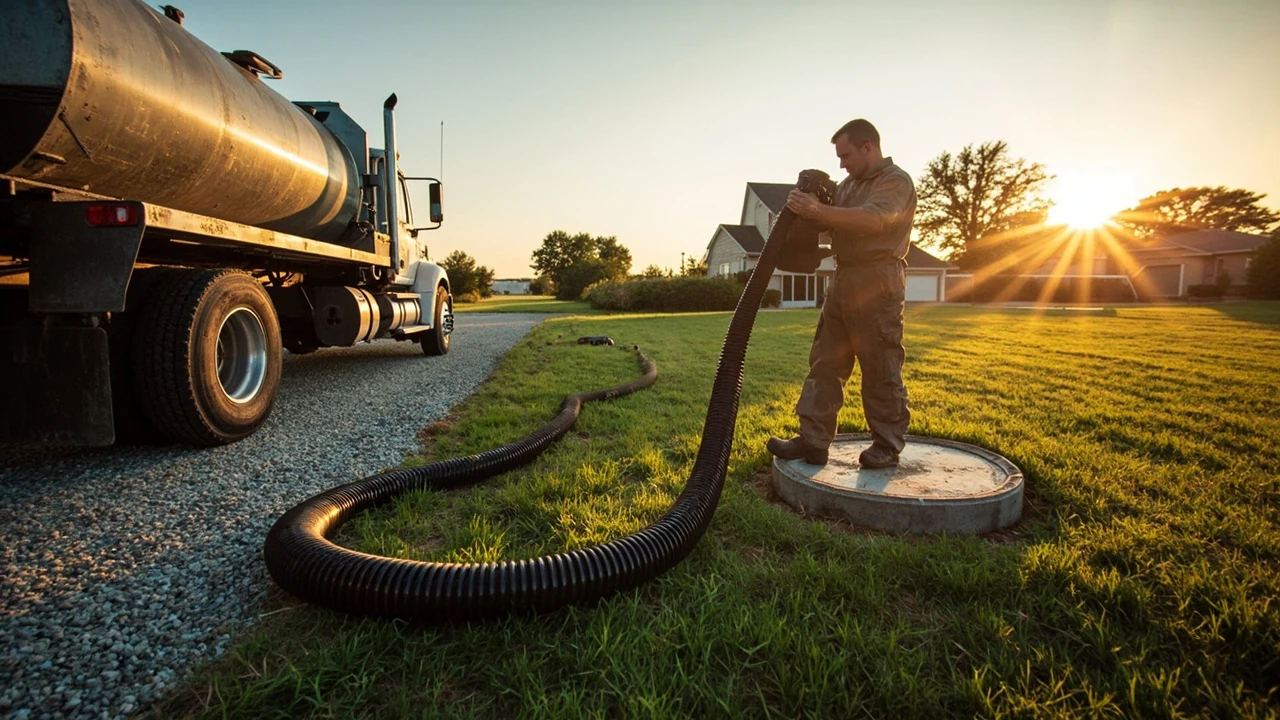
Septic tank pumping services: what they actually do for your home
A homeowner’s worst day with a septic system usually starts with a smell. It might be a sour, sulfurous odor drifting up from the lawn, or a wet patch that never dries above the drain field after a long rain. By the time those signs show up, the tank has often been past full for a while, and the fix is no longer a small one. Septic tank pumping services exist for exactly that reason: a vacuum truck arrives, the buried lid is located and opened, and the accumulated sludge and floating scum are removed so the system can keep treating household wastewater the way it was designed to.
What separates a routine pump-out from an emergency call is usually timing. A properly scheduled visit takes about an hour, costs a predictable amount, and leaves the homeowner with years of trouble-free service. A neglected tank can flood the drain field, back up into the house, or contaminate a well, and the repair bill climbs fast. The goal of this guide is to walk through what professional pumping really involves, when to schedule it, what it should cost in rough terms, and how to tell a careful, licensed hauler from someone who will leave you with the same problem next year.
What happens during a professional pump-out
The standard pump-out looks simple from the outside, but a careful technician follows a set of steps that protect both the tank and the drain field. Knowing the sequence helps a homeowner judge whether the work is being done correctly.
- Locate the tank and access lids. Most homes built after the 1980s have risers that bring the lids to grade, which makes this step quick. Older tanks often sit a foot or two underground, and the technician may probe with a metal rod or follow the outlet pipe to find the concrete cover.
- Inspect the tank before pumping. The lid is removed, and the technician checks the scum layer at the top, the sludge layer at the bottom, and the clear layer in the middle. A quick measurement tells them whether the tank is overdue, on schedule, or, in some cases, being pumped too often.
- Pump through the manhole, not the inspection port. The large central lid is opened so the vacuum hose can reach the full depth of the tank. Small inspection ports are meant for checking levels, not for removing solids.
- Empty the contents into a vacuum truck. A pump on the truck creates suction that pulls sludge, scum, and the clear wastewater layer into a sealed tank. Most haulers do not leave any of the liquid behind on purpose, because the tank refills with fresh household wastewater within a day.
- Inspect the baffles, tees, and walls. With the tank empty, the technician can see whether the inlet and outlet baffles are intact, whether the dividing wall between chambers is sound, and whether the concrete is showing serious cracking or corrosion.
- Inspect the drain field area for signs of failure. A short walk to the field, looking for wet spots, odor, or surfacing effluent, is a good sign that the hauler is thinking about the system, not just the truck load.
- Reseal the lids, restore the site, and provide a receipt. The receipt should include the date, the volume pumped, the condition of the tank, and where the waste was hauled for treatment.
That last item matters more than most homeowners realize. The septage has to be taken to a licensed treatment facility, and the hauler’s manifest is the homeowner’s proof that the waste was disposed of legally. If a contractor offers to dump waste on their own property or in a ditch, that is a serious red flag.
How often a septic tank actually needs pumping
The most common question homeowners ask is how often to schedule service. Honest answer: it depends on the size of the tank, the number of people in the house, the habits of the household, and the volume of solids that go down the drains. General guidance that holds up across most regions looks like this:
| Household size | Tank size (gallons) | Typical pumping interval |
|---|---|---|
| 1 to 2 people | 1,000 | Every 3 to 5 years |
| 3 to 4 people | 1,000 | Every 2 to 3 years |
| 5 to 6 people | 1,000 | Every 1 to 2 years |
| 3 to 4 people | 1,500 | Every 3 to 4 years |
| 5 to 6 people | 1,500 | Every 2 to 3 years |
| Large household or heavy water use | 2,000+ | Every 1 to 3 years |
Those ranges are not arbitrary. They reflect how fast indigestible solids accumulate compared with how fast bacteria can break them down. According to the overview in the septic tank article on Wikipedia, the rate of sludge buildup tends to outpace the rate of decomposition, which is why periodic removal is part of every properly functioning system. The article also notes that some systems can stretch to 10 or even 20 years between pumpings, but those are usually small households on large tanks with conservative water use, not typical family homes.
A few habits will push a household toward the shorter end of those intervals:
- Using a garbage disposal heavily, which sends extra food solids into the tank.
- Doing many loads of laundry in a single day, which can stir up solids and push them into the drain field.
- Flushing wipes, feminine products, cotton swabs, or cat litter, even when the packaging says “flushable.”
- Pouring grease, oil, coffee grounds, or paint down the drain.
- Running a water softener that discharges brine into the septic system.
None of these habits will break a tank in a week, but they will quietly shorten the pumping interval. A household that wants the longer end of the range usually combines a larger tank with restraint in the kitchen and bathroom, plus a basic three-year inspection cycle.
What septic tank pumping services should and should not include
Not every job quoted as a pump-out is the same. A careful contract will spell out what is included, and a careful homeowner will ask what is not.
| Service item | Usually included | Often an extra charge |
|---|---|---|
| Locating and uncovering tank lids | Yes, if risers are present | Often extra if digging is required to find the lid |
| Pumping both chambers | Yes | Should not be extra on a normal residential tank |
| Visual inspection of baffles and tank condition | Yes | A written inspection report may be quoted separately |
| Rinsing the tank with clean water | Sometimes | Some companies charge for “thorough cleaning” beyond a basic pump-out |
| Drain field inspection or treatment | No | Almost always a separate service |
| Repair of broken baffles or risers | No | Quoted as a separate repair visit |
| Filter cleaning or replacement | Sometimes | Many systems have an effluent filter that needs periodic rinsing |
| Septage disposal and manifest | Yes | Should never be billed as an add-on |
A reasonable rule of thumb: if the technician cannot tell you how many gallons the truck removed, where the waste was taken, or what the tank looked like inside, the service was probably rushed. A good hauler will explain each step in plain language and hand over a paper or digital receipt with the details.
How to choose a reliable pumping company
Septic work is one of the more lightly regulated home services in many states, which means the quality of a pumping company can vary widely. A short checklist helps separate the steady operators from the fly-by-night trucks.
- Licensing and permits. In most states, septage haulers need a specific license, and the truck has to display a permit number. Ask to see both, and check that they are current.
- Insurance. The company should carry liability insurance and, ideally, workers’ compensation. If a worker is hurt on your property and the company is uninsured, the liability can land on the homeowner.
- Experience with your system type. Concrete, fiberglass, and plastic tanks behave a little differently, and aerobic systems with mechanical components require a more careful visit. Ask whether the company regularly services your type of system.
- Written scope and pricing. A company that shows up with a flat per-gallon or per-tank price and explains what is included is easier to work with than one that quotes a low number and adds fees on site.
- References or reviews. Local reviews, neighbors who have used the company, and the local health department are all fair sources. A long track record in the same county is a good sign.
- Responsiveness to questions. If the office staff cannot answer basic questions about pumping intervals, baffle inspection, or drain field care, that is a signal about how the field work is likely to go.
Pricing varies by region, tank size, and accessibility, but a typical residential pump-out in the United States lands somewhere between a few hundred dollars and a bit over a thousand. Very low bids are worth questioning, because legitimate disposal fees alone are a meaningful part of the cost. Very high bids for a routine visit can sometimes reflect a company that has a small route and is covering its overhead on a single stop.
Warning signs that a pump-out is overdue
Septic systems tend to fail slowly, then all at once. Watching for the early signals can keep a routine service from turning into a drain field replacement.
- Slow drains throughout the house. A single slow sink is usually a clog, but multiple slow drains at once often point to a tank that is too full to accept new flow.
- Gurgling in the plumbing. Air bubbles forced back through traps suggest the tank is full and the system is struggling to vent.
- Sewage odors outdoors. A faint smell after a heavy rain is not unusual, but a persistent odor near the tank or drain field is a strong signal.
- Wet or spongy ground over the drain field. If the field is soggy when the rest of the yard is dry, the tank is likely sending undecomposed material into the field.
- Bright green grass over the drain field in dry weather. Nutrient-rich effluent can fertilize the lawn, but the same nutrient load is clogging the soil below.
- Sewage backing up into floor drains or lowest fixtures. This is the late-stage sign and usually means the call needs to happen the same day.
When several of these appear together, the next step is a pump-out plus a careful inspection. In some cases, the tank is fine and the drain field has failed. In others, the tank has simply been ignored and a pump-out buys the household several more years of normal use.
What a homeowner can do between pump-outs
Pumping is the most visible part of septic care, but everyday habits have a bigger effect on how long the system lasts. A few practical habits keep the tank in good shape between service visits:
- Spread water use across the week. A single load of laundry uses far less water than five loads in one afternoon, and the tank is happier with steady, modest input than with sudden surges.
- Keep grease out of the drains. Let cooking grease cool, scrape it into the trash, and wipe pans with a paper towel before washing. Grease solidifies in the tank and clogs the scum layer.
- Be cautious with “flushable” wipes. Most do not break down the way toilet paper does and tend to gather in the tank. The same is true for paper towels, dental floss, and cotton swabs.
- Avoid harsh chemicals in large doses. Normal household cleaners, used in normal amounts, will not hurt a healthy tank. Concentrated drain openers, paint thinners, and pesticides can disrupt the bacterial balance that makes the system work.
- Keep heavy equipment off the drain field. Parking a truck or storing a boat over the field compacts the soil and can crush the distribution piping underneath.
- Plant only shallow-rooted grass over the field. Trees and large shrubs send roots toward the moisture and nutrients in the field, where they can clog the pipes. A neat lawn is the safest cover.
- Keep records. A simple log of pumping dates, any repairs, and the names of contractors is useful for the next service call and, if the home is ever sold, for the buyer.
These habits are not exciting, but they are what separates a septic system that runs quietly for thirty years from one that needs a new drain field in fifteen.
Common questions about pumping cost and timing
A few practical questions come up on almost every service call, and it is worth thinking through them before the truck is in the driveway.
| Question | What to consider |
|---|---|
| Should I be home for the pump-out? | Not required, but helpful. The technician may need to confirm the location of the lid, ask about recent issues, and discuss any findings. |
| How long does the visit take? | Most residential pump-outs take 30 to 90 minutes, longer if digging is required or if the system needs more than a basic pump. |
| Can the truck reach my tank? | The vacuum hose is usually long enough to handle a typical yard, but tight access, long driveways, or tanks far from the parking spot can require extra setup. |
| Is it normal for the tank to fill back up fast? | Yes. The tank is designed to hold water at all times. Once the truck leaves, the tank refills with normal household wastewater within a day or two. |
| Will pumping fix a wet yard or bad smell? | Sometimes. If the cause is a full tank, yes. If the drain field itself is damaged, pumping will not solve the underlying problem. |
| Can I skip pumping if I use additives? | Additives can help maintain bacterial activity, but they do not remove the inert solids that accumulate over time. The pump-out still has to happen. |
How a septic system fits into the rest of home maintenance
Septic care tends to be invisible until it becomes a problem, which is one reason it gets less attention than it deserves. The same homeowner who keeps up with routine dryer vent cleaning and remembers the bathroom cleaning services schedule can easily forget the tank buried in the side yard. Treating the pump-out as one more scheduled task on the home calendar, on a three- to five-year cycle for most households, is usually enough to keep the system out of the urgent-repair category.
The bigger picture is straightforward. A septic system is a small, self-contained wastewater plant, and the only moving parts it really needs are the bacteria in the tank, the homeowner not abusing the drains, and a vacuum truck on a reasonable schedule. The cost of a pump-out spread over the years between visits is modest, and it buys insurance against the much larger cost of replacing a drain field or remediating a contaminated well.
Frequently asked questions
How do I know when my septic tank needs pumping?
Most households schedule pumping every 3 to 5 years, but the right interval depends on tank size and household habits. Watch for slow drains across the house, gurgling in the pipes, sewage odors outside, or unusually green grass over the drain field. If any of those signs show up, it is worth having the tank inspected right away.
What is the average cost of septic tank pumping services?
Costs vary by region, tank size, and accessibility, but most residential pump-outs in the United States fall somewhere between a few hundred dollars and a bit over a thousand. The price typically covers locating the lid, pumping the tank, a visual inspection, and proper disposal of the waste at a licensed facility.
Can I pump my septic tank myself?
Household pump-out is not a practical DIY project. The waste has to be removed with a commercial vacuum truck and disposed of at a licensed treatment site, both of which require specialized equipment and permits. A professional hauler is the only realistic option for routine pumping.
How long does a septic tank pumping service take?
A straightforward residential visit usually takes 30 to 90 minutes. The job takes longer if the lid has to be located with probing, if the technician has to dig down to the cover, or if the system needs more than a basic pump-out.
Will pumping my tank fix a bad smell in the yard?
If the smell is caused by a full tank, a pump-out will usually clear it up within a day or two. If the smell continues after pumping, the problem is more likely in the drain field, and a follow-up inspection is a good idea.
Is it safe to use the toilet and sinks right after pumping?
Yes. Normal water use can resume as soon as the technician finishes and reseals the lid. The tank will refill with household wastewater, which is the condition it is designed to operate in.
Do septic tank additives replace the need for pumping?
No. Additives can support the bacterial activity in the tank, but they do not remove the inert solids that gradually accumulate at the bottom. Periodic pumping is the only way to get those solids out, and no additive on the market changes that.
What should I keep out of the septic system?
Grease, oil, coffee grounds, “flushable” wipes, paper towels, feminine products, cotton swabs, cat litter, and large amounts of harsh chemicals should all stay out of the drains. The system is designed for normal household wastewater, and every one of those items shortens the time between service calls.
How do I find the lid of my septic tank?
If the system was built with risers, the lids are at ground level and easy to spot. Older tanks may sit a foot or two underground, and a professional hauler can probe the soil with a metal rod or follow the outlet pipe to locate the cover. Many county health departments also keep records of where the tank was originally installed.
Can heavy rain affect when I should schedule pumping?
Yes. A saturated drain field or a high water table can make a borderline tank behave like a failing one, with soggy ground and slow drains. It is usually better to wait for normal soil moisture and then assess the system, since pumping during saturated conditions does not always reveal the true condition of the tank and field.
Leave a Reply