
Sewer replacement: what it really means for your home and yard
A cracked or collapsed sewer line is not something most homeowners think about until raw water is pooling in the basement or a gurgling toilet is the loudest sound in the house. By the time you notice the warning signs, the pipe under the yard has often been deteriorating for years, quietly undermined by tree roots, shifting soil, or a material that was never meant to last this long. Sewer replacement is the project that fixes that problem at its source, by removing the failed section of pipe and installing a new line that can carry wastewater away from the home for decades.
For most property owners, the phrase “sewer replacement” sounds like a worst-case scenario. In practice, it is a well-understood piece of construction work that licensed plumbing contractors handle every day. The job can be messy for a short window, but a good crew keeps the disruption limited to the trench, the access pit, and a few days of careful restoration. The hard part is knowing when repair is no longer enough, and what choices you will face once replacement is on the table.
This guide walks through the decisions that matter: how to recognize that the line really is failing, what a contractor will actually do on site, how long the work takes, what the realistic price range looks like, and how the trenchless and open-cut methods compare. It is written for a homeowner or property manager who wants a clear, practical view of the project before requesting quotes.
What a residential sewer line actually does
The sewer line is the single pipe that connects your home’s drain system to the municipal main in the street, or to a private septic system in rural areas. Every drain in the house, from the kitchen sink to the basement floor drain, eventually flows into that one pipe. Because it sits below frost line and below the foundation, it is out of sight and out of mind for most of its service life.
Older homes often have sewer lines made from materials that have since been improved upon:
- Clay tile, common in houses built before the 1970s, in sections that can shift apart at the joints.
- Orangeburg, a wood-fiber and tar composite used from the 1940s through the 1970s, which deforms under pressure over time.
- Cast iron, which is durable but corrodes from the inside as it ages.
- Asbestos cement, found in mid-century homes, which can crack but does not corrode.
- PVC, the modern standard for new installations, which is smooth, lightweight, and resistant to root intrusion at the joints.
- HDPE, a flexible plastic used for trenchless replacement and for newer municipal connections.
Each material has a different expected lifespan and a different failure mode. A clay line often loses the battle to tree roots at the joints. Cast iron narrows from the inside as rust builds up. Orangeburg slowly flattens. Knowing what is in the ground tells you a great deal about how the line will eventually fail, and that is information a good contractor will look for before quoting a replacement.
Why sewer lines fail in the first place
Sewer pipes are under constant stress. They carry hot and cold water, solids, grease, soap residue, and anything else that goes down a drain. They sit in soil that shifts with moisture and frost, and they are sometimes invaded by roots searching for the water inside. Any one of these forces can shorten the life of a line; together, they almost always do.
The most common causes of failure include:
- Tree root intrusion, where roots find a joint or a crack and slowly fill the pipe.
- Pipe aging, especially in clay, cast iron, and Orangeburg lines that have reached the end of their design life.
- Ground movement, from settling soil, frost heave, or nearby construction that shifts the trench.
- Heavy surface loads, such as a driveway or a parked vehicle directly above a shallow pipe.
- Internal corrosion, particularly in cast iron lines that carry aggressive water.
- Poor original installation, including flat spots that let solids settle and bellies that hold water.
Homeowners are often surprised that a sewer line is rated to last 50 to 100 years for modern materials, yet still fails within a single ownership. The lifespan estimate assumes normal soil, normal loads, and a careful installation. In a tight urban lot with mature trees, the real-world number is often shorter.
Warning signs that point to a failing sewer line
Sewer problems rarely arrive without warning. The pipe communicates through small changes in drainage, smell, and surface conditions, and those signals usually appear months before a true backup. Recognizing them early is the difference between a planned replacement and an emergency call on a Sunday night.
Pay attention to:
- Multiple fixtures draining slowly at the same time, especially the lowest drains in the house.
- Gurgling sounds from a toilet or tub when a nearby fixture is used.
- Sewer odor in the yard, basement, or around floor drains.
- Unexplained wet spots or unusually green strips of grass along the sewer route.
- Sinkholes or soft depressions in the yard where the line runs.
- Rodent or insect activity near floor drains, which can follow a broken line into the house.
- Recurring clogs that return within weeks of a professional cleaning.
Any one of these signs is worth a closer look. Two or more at the same time usually means the line itself is the problem, not a single fixture. At that point, a video inspection is the next reasonable step, because it shows the inside of the pipe in real time and gives the contractor a basis for a replacement plan rather than a guess.
How a contractor decides between repair and full replacement
Not every failed line needs a full replacement. A single cracked section, a shifted joint, or a root intrusion at one point can often be repaired with a spot fix. The decision comes down to how much of the line is compromised, what material it is made of, and how long the homeowner plans to stay in the home.
A contractor will typically recommend a full sewer replacement when:
- The pipe is made of Orangeburg or another material that has reached the end of its useful life.
- Video inspection shows cracks, offsets, or collapses at several points along the run.
- The line has a noticeable belly that holds water and solids.
- Root intrusion keeps returning after repeated cleanings.
- The pipe is undersized for the home’s current or expected use.
- A repair would require tearing up finished spaces, driveways, or mature landscaping.
Repairs make sense for newer PVC lines with a single failure point, or for historic properties where preserving the original alignment matters more than long-term peace of mind. Replacement makes sense when the pipe would need repeated attention for the rest of its life anyway. Spending a little more now often removes the next ten years of service calls.
Two main methods: open-cut and trenchless replacement
Sewer replacement work is usually described in one of two ways. The difference is how the new pipe gets into the ground.
Open-cut replacement
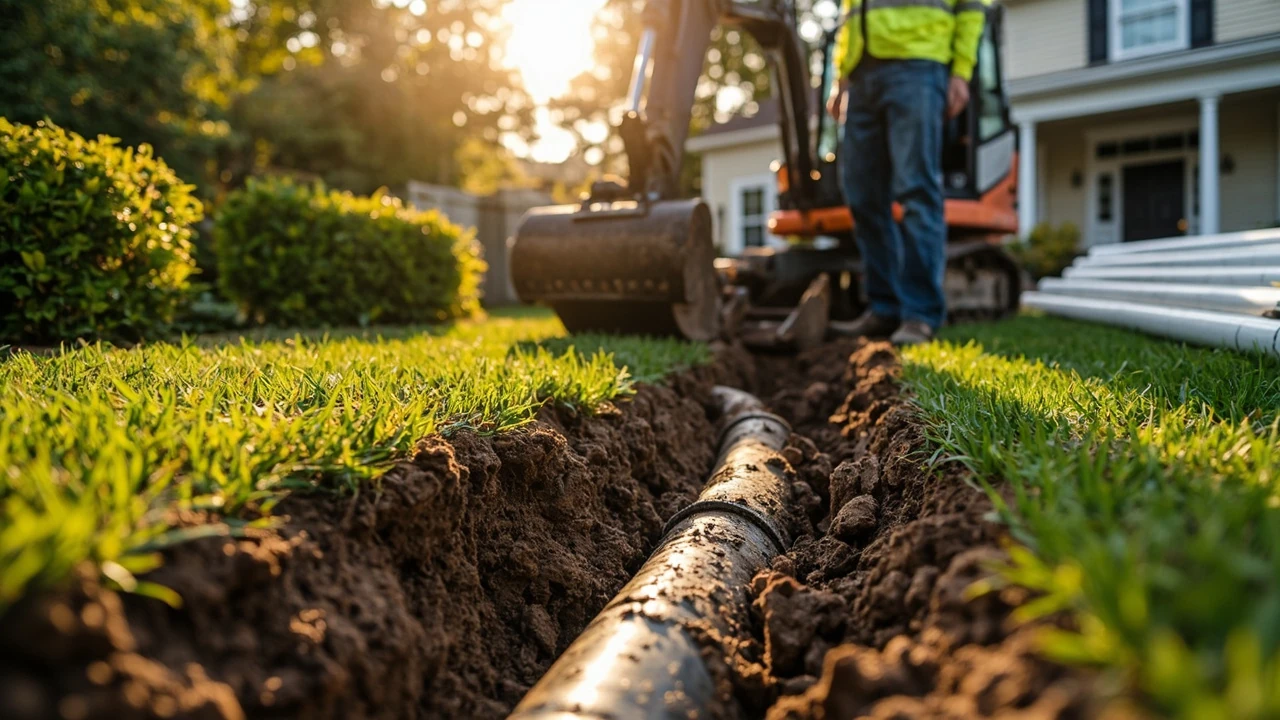
Open-cut is the traditional method. The crew excavates a trench along the entire length of the line, removes the old pipe, lays the new pipe on a prepared bed of granular material, and backfills once the line has been inspected and tested. It is the most common approach for residential jobs because it is straightforward, it works in nearly every soil condition, and it allows the crew to see and correct problems such as a collapsed section or a hidden utility crossing.
The trade-off is surface disruption. The trench passes through whatever sits above the pipe: lawn, garden beds, walkways, driveways, and occasionally the edge of a patio. Restoration is part of the project, but a homeowner should expect some settling in the trench line for the first year and may want to plan for re-sodding or minor landscaping the following season.
Trenchless replacement
Trenchless methods replace the line through small access points rather than a continuous trench. The two most common residential techniques are pipe bursting and cured-in-place pipe lining.
- Pipe bursting pulls a new HDPE pipe through the old line while a bursting head fractures the existing pipe outward into the surrounding soil.
- CIPP lining inserts a resin-saturated felt tube into the old pipe, then cures it in place with hot water, steam, or UV light to form a new pipe within the old one.
Trenchless work is attractive when the surface above the line is finished or hard to restore: a driveway, a patio, mature trees, or a building addition. It is also faster on the surface, often a day rather than several, and limits the size of the excavation to one or two small pits. The trade-offs are cost per foot, which is often higher, and limitations on what the existing pipe can look like. A line that has collapsed, is severely offset, or has a major belly usually cannot be lined and may not be a good candidate for bursting either.
Comparing the two approaches side by side
Both methods can produce a long-lasting sewer line. The right choice depends on the condition of the existing pipe, the surface above it, the local code, and the homeowner’s tolerance for disruption.
| Factor | Open-cut replacement | Trenchless replacement |
|---|---|---|
| Typical surface disruption | Continuous trench along the full line | One or two small access pits |
| Suitable pipe conditions | Almost any condition, including collapsed or severely offset lines | Mostly intact host pipe without major bellies or collapses |
| Common new pipe material | PVC, schedule-rated for depth and load | HDPE (bursting) or resin-impregnated liner (CIPP) |
| Restoration scope | Lawn, garden beds, walkways, possibly driveway | Limited to access pits and entry points |
| Time on site | Two to five days for most homes | One to two days for most homes |
| Cost driver | Excavation and restoration labor | Specialized equipment and materials |
| Best fit | Older failing pipes, bellies, full-length replacement | Finished surfaces, mature landscaping, shorter runs |
A reputable contractor will look at the video inspection, the depth of the line, the soil report if one is available, and any easements or utility crossings before recommending one method over the other. Homeowners should feel comfortable asking why a particular approach is being suggested, and what the trade-offs are in their specific case.
What happens during a typical replacement project
Once the scope is set, a sewer replacement follows a predictable sequence. Knowing the steps ahead of time makes it easier to plan around the work, especially if the home will be occupied during the job.
- Permitting and locates. The contractor pulls the local plumbing permit and calls the utility-locate service to mark gas, water, electric, and communication lines in the work area.
- Site preparation. The crew lays plywood over sensitive surfaces, removes small sections of fence if needed, and confirms the route with the homeowner.
- Excavation. A small excavator or a hand dig opens the trench or the access pits down to the depth of the line.
- Pipe removal. The old pipe is cut out and lifted away. If the line is being lined, it is cleaned and inspected again before the liner is installed.
- New pipe installation. The new pipe is laid on a bed of granular material, fitted, and connected to the house and the municipal tap or septic tank.
- Inspection and testing. The local inspector verifies the slope, the connections, and a pressure or air test before backfill.
- Backfill and compaction. The trench is filled in layers and compacted to limit future settling.
- Surface restoration. Sod, topsoil, concrete, or paving is replaced to match the original condition as closely as practical.
The crew should leave the site clean and the home’s plumbing working at the end of each day, even if the project runs over more than one day. Overnight, the line is typically capped or temporarily reconnected so the household can use its drains normally.
Realistic cost ranges for a residential sewer replacement
Costs vary widely by region, depth, length, surface conditions, and method. A useful way to think about pricing is in three layers: the cost per foot, the access and restoration work, and any required permits or inspections.
| Cost element | Typical range | What drives it |
|---|---|---|
| Cost per foot of pipe | Around $50 to $250 per foot, including labor and materials | Method (open-cut vs trenchless), pipe material, soil conditions, depth |
| Excavation and access | Often a flat fee per project | Length of run, presence of concrete or hardscape, utility conflicts |
| Surface restoration | Often a flat fee per surface type | Lawn, garden, driveway, walkway, patio, or street cut |
| Permits and inspections | Set by local jurisdiction | City or county fee schedule, number of inspections |
| Video inspection | Often a separate line item | Whether inspection is done before, during, or after the work |
For a typical single-family home, a full sewer replacement often lands in a four-figure range, with longer runs, deeper lines, or difficult access pushing it higher. A short, shallow replacement in soft soil with minimal surface work can be at the lower end. A long, deep run under a driveway or a finished patio can be at the upper end or more. Pricing is regional, so a few local quotes are the only reliable way to budget.
How long the work takes and how long the new line will last
Most residential sewer replacements are completed in one to three days of active work, with additional time for inspection and restoration. A complex project that involves a street cut, a deep line, or coordination with the municipality can stretch to a week or more, but those cases are unusual for a single-family home.
The new line itself is expected to last for decades. PVC, the most common replacement material, is generally rated for 50 to 100 years of service under normal conditions. Trenchless HDPE and CIPP liners have similar design lives when properly installed. The realistic answer is that a homeowner who replaces a failing line today is unlikely to need another replacement on that same line.
Preventive maintenance still matters. A periodic professional cleaning, often on an 18 to 24 month schedule, keeps the line clear of buildup and lets a technician catch small issues before they grow. Treating the line as a long-lived piece of infrastructure, rather than a one-time fix, is what keeps it trouble-free.
Choosing a contractor for the work
Sewer replacement is not a routine handyman job. It requires a licensed plumbing contractor, a permit, and a final inspection by the local authority. Choosing the right contractor is the single biggest factor in how the project actually goes.
Useful criteria include:
- A clear written scope that names the method, the pipe material, the depth, the length, and what restoration is included.
- A video inspection report with timestamps and locations, not just a verbal description.
- Proof of license, insurance, and workers’ compensation coverage.
- Familiarity with local permitting and inspection requirements, including who schedules the inspection.
- References from recent projects of similar scope, ideally in the same neighborhood or soil type.
- A warranty on both the materials and the workmanship, with the term stated in writing.
Two or three written quotes are worth the time. The lowest bid is not always the best value, and the highest is not always the most thorough. What matters is whether the scope matches the inspection findings, whether the contractor is willing to explain the plan, and whether the warranty terms are clear.
Planning ahead if you are buying or selling a home
Sewer lines are a common surprise during real estate transactions. Buyers who fall in love with a house in a mature neighborhood may not realize that the clay or Orangeburg line in the yard is near the end of its life. Sellers who have lived with slow drains for years may not have looked at the line at all.
A pre-purchase video inspection is a small cost compared with the price of a replacement, and it gives both sides a clear picture of the line’s condition. If the inspection finds a problem, the parties can negotiate a credit, a repair, or a price reduction. A sewer inspection is also useful for sellers, because it lets them address issues before the buyer’s inspector finds them, which tends to produce a calmer transaction.
For properties with mature trees, history of backups, or original mid-century plumbing, a sewer inspection is one of the more valuable pre-purchase checks available. It turns a hidden infrastructure risk into a known, budgetable item.
Common mistakes homeowners make with a failing line
Most sewer problems are not caused by the pipe. They are caused by decisions made after the first warning sign.
- Treating recurring clogs as a fixture problem, when the line itself is failing.
- Using chemical drain cleaners repeatedly, which can damage older pipes and rarely clears a real blockage.
- Delaying a video inspection because the drains are “working for now.”
- Choosing a repair because it is cheaper, when the pipe’s condition points to a full replacement.
- Skipping the permit to save on cost or time, which can create problems with insurance and resale.
- Planting new trees or building a patio directly over the line without knowing its path.
Each of these decisions is understandable in the moment, and each adds cost or risk later. A clear diagnosis, a written scope, and a contractor who explains the trade-offs are the simplest way to avoid them.
How to prepare your home and family for the work
A sewer replacement touches the yard, the driveway, and the home’s plumbing. A little preparation makes the project go more smoothly.
- Clear the work area of movable items, including patio furniture, garden decor, and vehicles.
- Identify any private utilities, such as landscape lighting, sprinkler lines, or low-voltage wiring, that the locate service may not mark.
- Plan for one day without full use of the home’s drains if the project requires the line to be offline during tie-in work.
- Keep pets and children away from the trench and the equipment, both for safety and to avoid slowing the crew.
- Ask the contractor where materials will be staged and how the crew will access the site each day.
- Confirm the contact person for the inspection and the planned backfill date.
Most crews are accustomed to working around occupied homes and will keep the disruption contained. A short conversation at the start of the project sets expectations and avoids surprises.
After the work is done: what to watch for in the first year
A new sewer line should perform quietly for decades. The first year is mostly about watching the restoration settle and confirming that the system is working as expected.
- Expect some settling along the trench line for the first several months. Top up with topsoil or sand as needed.
- Re-sod or re-seed in the right season, and water the new grass through its first summer.
- Watch for any return of slow drains or odors. None should appear after a successful replacement.
- Keep a record of the video inspection, the permit, the final inspection sign-off, and the warranty for future owners.
- Schedule a professional cleaning on the maintenance interval the contractor recommends.
Documentation matters. A clean paper trail of what was found, what was installed, and what was inspected protects the homeowner if a question comes up during a future sale or insurance claim.
Frequently asked questions
How do I know if I need a sewer replacement instead of a repair?
A video inspection is the most reliable way to tell. A single crack or offset can often be repaired, but multiple problem points, a collapsed section, a noticeable belly, or a line made of a material that has reached the end of its life usually point to a full replacement.
How long does a typical residential sewer replacement take?
Most single-family homes are completed in one to three days of active work, with additional time for inspection, backfill, and surface restoration. Complex projects that involve a street cut or a deep line can take longer.
What is the average cost of a sewer replacement?
Pricing varies by region, depth, length, surface conditions, and method. A common rule of thumb is around $50 to $250 per foot of pipe, with separate line items for excavation, restoration, permits, and inspection. Local quotes are the only reliable way to budget.
Can a sewer line be replaced without digging up the yard?
Sometimes. Trenchless methods such as pipe bursting and cured-in-place lining can replace a line through small access pits instead of a continuous trench. They are not suitable for every condition, especially collapsed or severely offset pipes, but they are a good option when the surface above the line is finished or hard to restore.
What pipe material is best for a new sewer line?
PVC is the most common modern choice for residential replacement. HDPE is used for trenchless installations. Both are rated for long service lives under normal conditions. The right material depends on local code, soil conditions, and the method being used.
How long will a new sewer line last?
Modern PVC and HDPE lines are generally expected to last 50 to 100 years under normal conditions. Trenchless liners have similar design lives. Preventive cleaning on a regular interval helps the line reach that full lifespan.
Do I need a permit for a sewer replacement?
Yes, in nearly every jurisdiction. A licensed plumbing contractor typically pulls the permit, schedules the inspection, and coordinates with the local authority. Working without a permit can create problems with insurance coverage and with the sale of the home later.
Should I get a sewer inspection before buying a house?
For most older homes, a pre-purchase video inspection is well worth the cost. It turns a hidden infrastructure risk into a known condition and gives both buyer and seller a basis for negotiation if the line needs work.
What is the difference between a sewer line and a septic line?
A sewer line carries wastewater from the home to a municipal main. A septic line carries wastewater from the home to an on-site septic system. The materials, slope, and code requirements are similar, but the destination, and therefore the maintenance considerations, are different.
How can I reduce the risk of future sewer problems?
Avoid flushing wipes, paper towels, and other non-degradable products. Keep grease out of the drains. Plant trees away from the sewer route. Schedule a professional cleaning on the interval your contractor recommends, and address small issues before they grow.
For a closer look at how a full replacement is scoped and priced in a residential setting, the [Sewer Replacement and Cleaning](https://jeffcoservices.com/sewer-replacement-and-cleaning/) guide from Jeffco Services walks through the same warning signs, methods, and cost considerations from a contractor’s point of view. For background on how a sewer system connects to the wider wastewater network, the [Wikipedia article on sanitary sewers](https://en.wikipedia.org/wiki/Sanitary_sewer) is a useful reference on pipe materials, layouts, and the difference between sanitary and combined systems.
Leave a Reply